


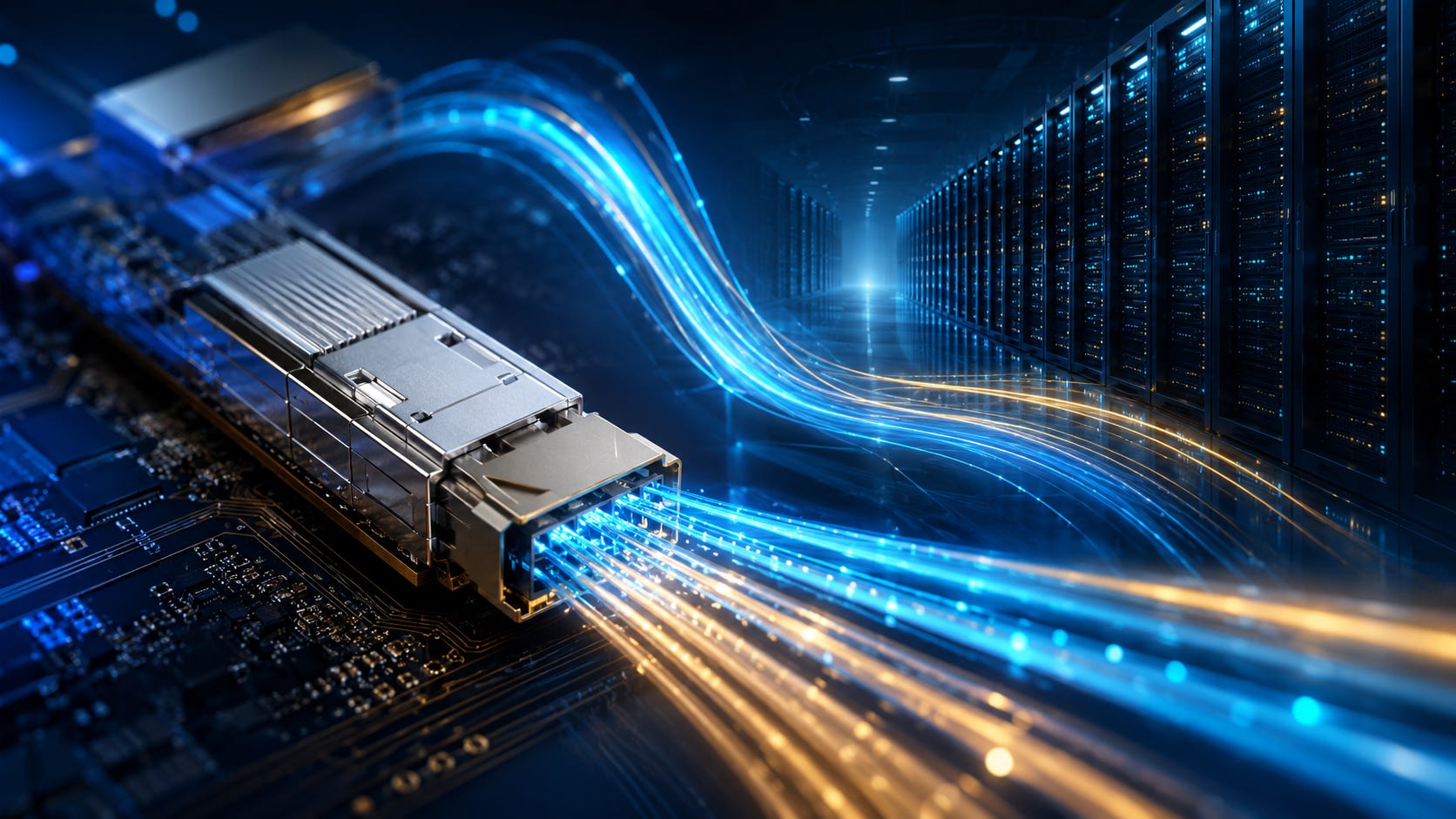
Photonics has become one of the hottest themes in the semiconductor market. Players like Lumentum and Coherent are up more than 600% and 200% over the past year. Nvidia is also investing billions in optical technology for its next generation of AI infrastructure.
AI needs to move more data at higher speeds, and traditional copper connections are starting to reach their limits. Photonics uses light to move data faster and with less power. This is becoming more important as AI demand grows.
But with so many companies competing in this fast-growing market, which ones are in the best position?
In this article, we’ll look at:
🔦 What photonics is and why it matters now
📈 How big the photonics opportunity could become
♟️ The key players in the photonics market
⚖️ The bull and bear case for photonics
🏆 Finally, we’ll share which companies we think are in the best position to win
🔦 Photonics Explained
Before looking at the opportunity, let’s first explain what photonics is.
Computers traditionally use electrical signals to move data through copper connections. Photonics works differently. It uses light, or photons, to move information. Data is turned into light, sent through optical fiber, and then turned back into data.
The technology isn’t new. Fiber-optic networks have used light to move data over long distances for decades. But AI is creating a much bigger need for it. Modern AI systems connect thousands of GPUs that work together and constantly exchange large amounts of data. As these systems get bigger, more GPUs need to communicate with each other and exchange more data at higher speeds.
This is where copper starts to struggle. Copper isn’t going away and still works very well over short distances. But at higher speeds, the distance it can cover becomes shorter. Optical connections can move data over longer distances at high speeds, while using less power. Light can also carry multiple streams of data at the same time, increasing the amount of data a single connection can handle.
Power also matters. AI data centers require a lot of electricity, so using less power to move data becomes more important as these systems grow.
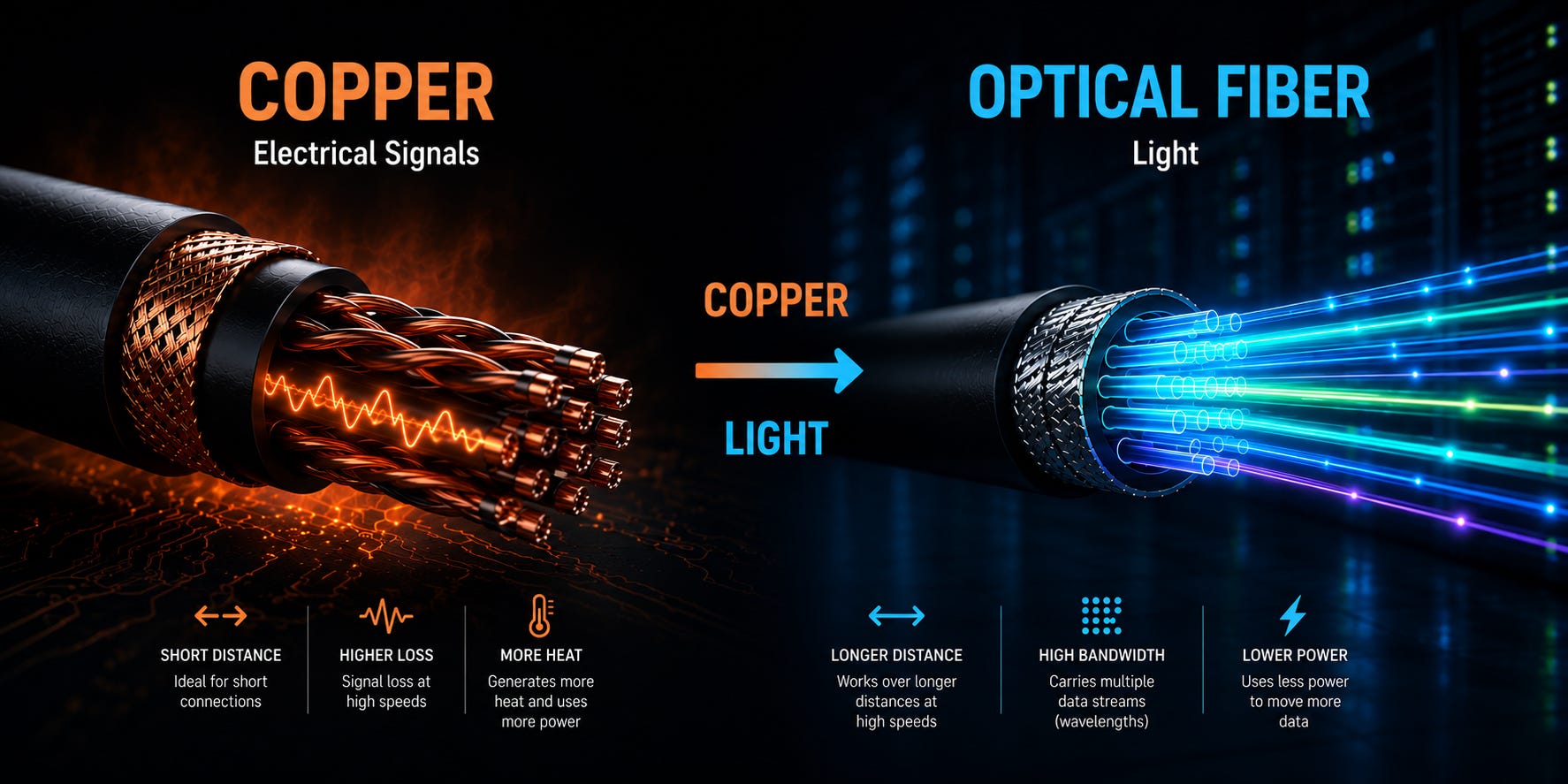
Source: NVIDIA, Intel | Visual adapted with ChatGPT
Another important development is Co-Packaged Optics (CPO). Today, optical components are typically connected to networking chips through separate modules. CPO brings the optics much closer to the chip, reducing power use and allowing more data to move faster. This could become an important part of the next generation of AI data centers.
AI doesn’t just need more computing power and memory. It also needs a faster and more efficient way to move all that data.
📈 The Photonics Opportunity
AI systems keep getting bigger and need to move more data. So how big could the opportunity for photonics become?
Goldman Sachs estimates that the aggregate networking TAM for AI systems could grow from around $15 billion with Nvidia’s GB300 NVL72 in 2026 to $154 billion with Rubin Ultra NVL576 in 2028. That’s a 9x increase in just two years. Rubin Ultra NVL576 is Nvidia’s next-generation AI system, connecting 576 GPUs across eight racks, compared with 72 GPUs in a single GB300 NVL72 rack today.
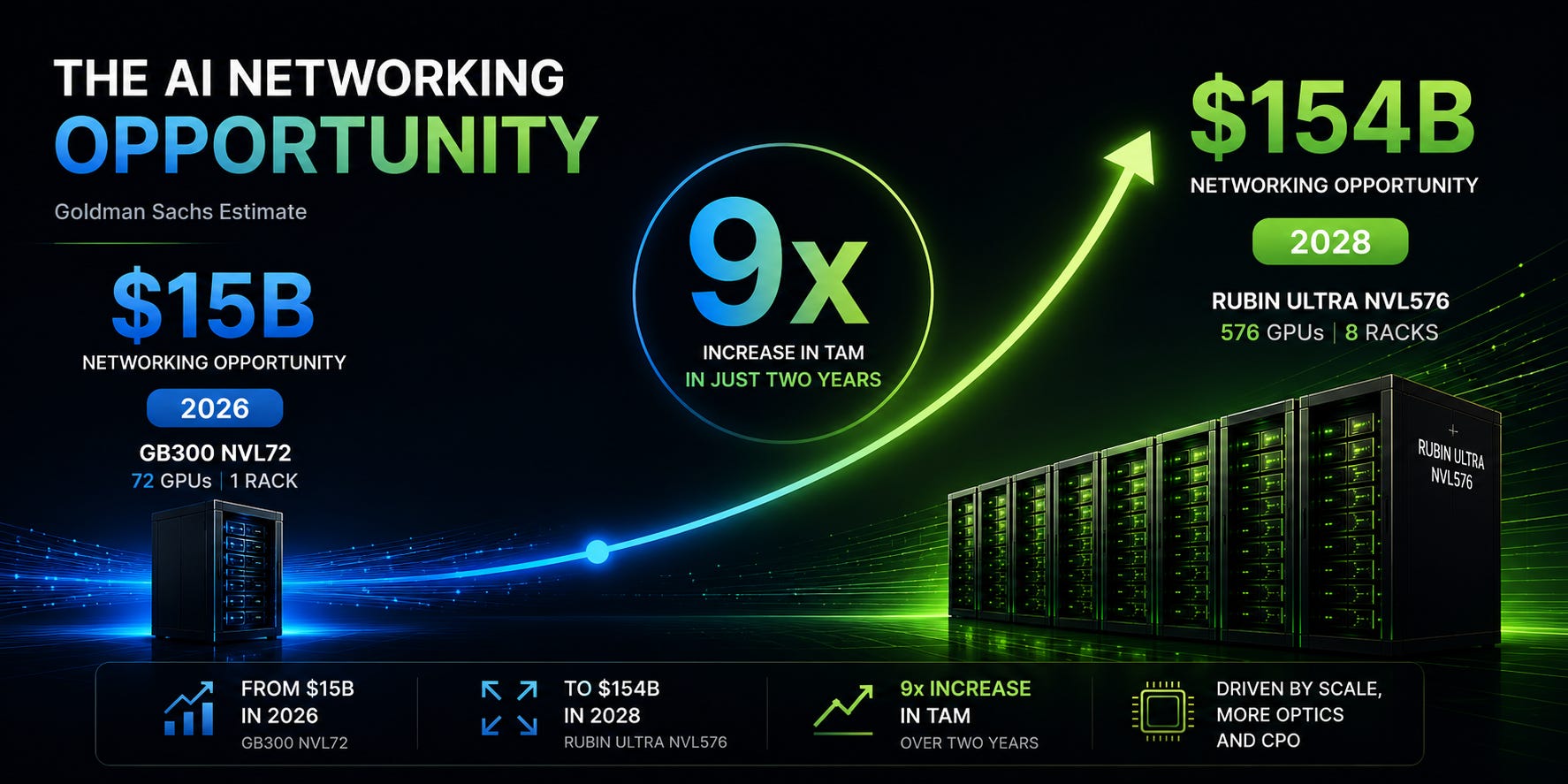
Source: Goldman Sachs Global Investment Research, “Optical Networking: The Next Mega Trend in AI Infrastructure” (May 2026).
A large part of this growth could come from photonics. Today, optical connections are used to connect different racks and larger parts of an AI network. As AI systems grow, optics is moving further into these systems and is being used to connect GPUs across multiple racks. Goldman Sachs estimates that the addressable market for optical modules and optical engines could grow 13x as optics expands into these new connections.
CPO could become an important part of this market. For Rubin Ultra NVL576, Goldman Sachs estimates that CPO could represent $91 billion, or 59% of the total $154 billion networking opportunity.
Connections are also getting much faster. Today’s AI networks use connections of up to 800 gigabits per second (800G). The industry is moving toward 1.6 terabits per second (1.6T) in 2026, which means a single connection can handle twice as much data. With Rubin Ultra in 2027–2028, Nvidia is expected to move toward 3.2T, doubling the capacity again.
This means the photonics opportunity is growing in two ways. AI systems need more optical connections, and those connections need to handle more data.
So far, we’ve explored why photonics is becoming increasingly important for AI infrastructure and how large the opportunity could become.
In the rest of this article, we’ll look at the key players ♟️, the bull 🐂 and bear case 🐻, and finally which companies we think are best positioned to benefit 🏆
This content is exclusively available to our paid subscribers ✨
🔥 Upgrade Now and Save 30%!
Get instant access to this article, our Portfolios & Transactions, our monthly Best Buys, all 15 Deep Dives, all 95+ Stock Battles — plus 420+ premium articles to explore!
✅ Trusted by 4,800+ investors.
♟️ The Key Players
The photonics market is not one single business. Different companies play different roles across the optical supply chain, from lasers and optical components to connectivity chips and photonics manufacturing.
🔦 Optical Components & Transceivers
These companies make the hardware that turns electrical signals into light and back again.