


February has come to an end and it was a volatile month across global markets 🌍📈📉
In this recap, we break down what moved the markets last month. How did the major indexes perform? How did our portfolios do? Which stocks held up best, which ones underperformed, and what moves did we make along the way?
Read our full February Recap below 👇
📢 Our Best Buys for March are coming later this week — don’t miss out! 🎯
What Moved the Markets in February?
February was a volatile month for global markets.
Geopolitically, things were relatively calm compared to January. But on the very last day of February, everything changed. The United States and Israel launched a major military attack on Iran. In that attack, Iran’s Supreme Leader, Ayatollah Ali Khamenei, was killed. Iran responded quickly with missile and drone attacks on U.S. and Israeli forces in the Middle East. What this means for the markets will likely become clear in the coming days, and much will depend on how Iran chooses to respond further.
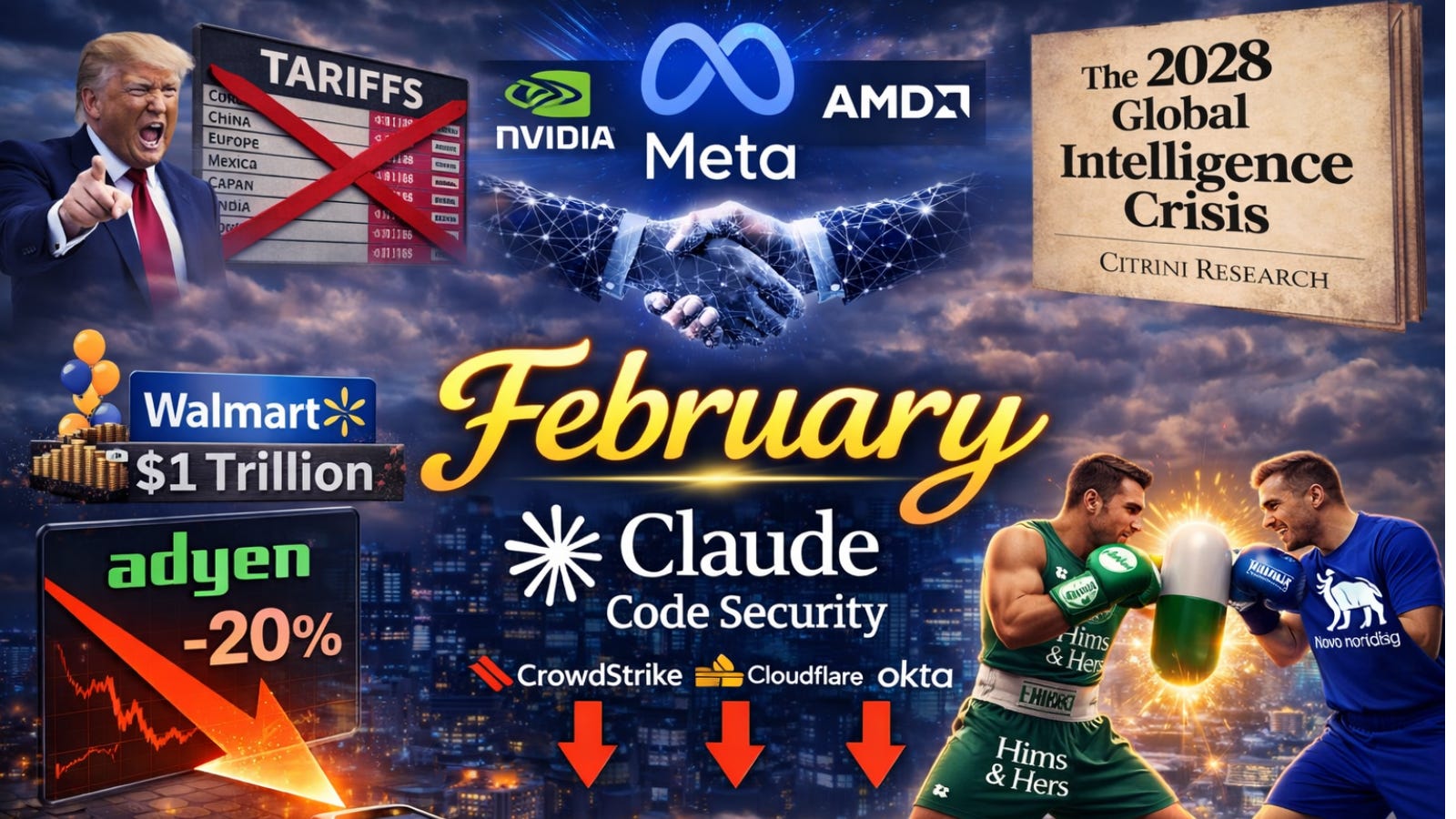
Earlier in the month, the U.S. Supreme Court ruled that former President Trump’s tariffs were unlawful. Trump responded quickly by announcing a new 10% global tariff, with the intention to increase it to 15% under Section 122 of the Trade Act of 1974. This added a new layer of uncertainty to global trade policy.
February was another tough month for software stocks. Anthropic launched Claude Opus 4.6, while OpenAI introduced OpenAI Frontier. Investors are increasingly worried that AI agents could replace (parts of) traditional software. Wondering how we think about this? You can read our full view in The Software Reset: Who Survives?
Markets also weakened late in February after a report from Citrini Research warned of a potential “2028 Global Intelligence Crisis.” The report describes a scenario where AI is not a bubble, but instead develops so quickly that many white-collar workers are replaced by AI and laid off. This would reduce consumer spending, weaken the economy, and push companies to rely even more on AI to cut costs — leading to even more layoffs and creating a vicious cycle. According to the report, this dynamic could eventually result in deep economic crisis and a market downturn by 2027–2028.
Big Tech companies generally reported good earnings, but most of the shares still fell. The reason: worries that capital spending (capex) is rising fast. Hyperscaler capex (the big cloud and AI infrastructure spend) is now expected to be well over $600 billion this year, which makes investors nervous about future profits.
Then let’s look at the most important company highlights from last month:
Walmart crossed a major milestone, reaching a $1 trillion market cap for the first time ever. At the same time, Amazon reported higher annual revenue than Walmart for the first time in history.
In healthcare, Hims & Hers launched a copy of Novo Nordisk’s weight-loss drug Wegovy. The FDA made clear that these copies are only allowed during official shortages and reminded companies to follow the rules. Soon after, Hims & Hers removed the product from its platform. Novo Nordisk then sued the company for selling an unauthorized version of its drug. As a result of the regulatory pressure and the lawsuit, Hims & Hers shares fell sharply during the month.
Novo Nordisk also disappointed investors with weaker-than-expected results for its new drug CagriSema, showing 23% weight loss compared to 25.5% for Tirzepatide from Eli Lilly. Novo Nordisk shares dropped 15% in one day after the news.
Adyen fell around 20% after giving a slightly weaker outlook for 2026. The company now expects revenue growth of 20–22%, instead of the earlier 20–25% range.
Finally, Meta announced a multi-year deal with Nvidia to buy millions of next-generation AI chips, including Vera Rubin GPUs and standalone CPUs. This clearly shows that investment in AI infrastructure remains very strong.
Many individual stocks are trading well below their 52-week highs, but the major indexes remain relatively stable. Under the surface, however, a lot is happening. Software stocks are under strong pressure, and we are seeing a rotation away from high-growth names toward more defensive sectors such as consumer staples and utilities. Investors are becoming more cautious and positioning for more uncertainty in the months ahead.
So how did the three major indexes respond? Let’s take a quick look at their February performance:
S&P 500: -0.9% 📉 (+0.5% YTD)
Nasdaq: -3.4% 📉 (-2.5% YTD)
Dow Jones: +0.2% 📈 (+1.9% YTD)
🔥 Upgrade now to paid and get 30% off!
Unlock full access to this Portfolio Review, our Top 10 Picks 2026, our Portfolios, our monthly Best Buys, all Deep Dives — plus 375+ premium articles.
✅ Already trusted by 4,400+ investors.
Portfolio Performance: How Did We Do?
How did our portfolios perform in February?
In this update, we compare our results to the S&P 500, Nasdaq, and Dow Jones, highlight our top performers, and walk you through the key moves we made throughout the month.
Market volatility created attractive opportunities, allowing us to add high-quality companies at fair prices and further strengthen our long-term positioning.
Curious about the exact moves we made? Discover the full breakdown below 👇
✨ Available exclusively to our paid members.