



Last Friday, history was made. SpaceX officially went public in the largest IPO ever. The stock gained almost 50% during its first days of trading, lifting the company's valuation to $2.66 trillion. The company is now the fifth most valuable company in the world. The IPO also made Elon Musk the first trillionaire in history.
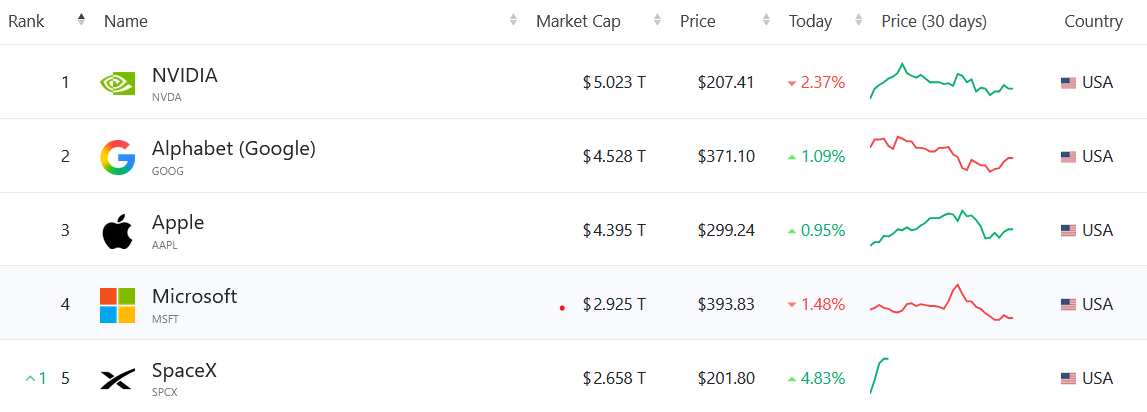
Source: Companies Market Cap - Largest Companies by Marketcap
Many investors believe the company could become one of the most valuable companies in the world over the next decade. Others think a $2.66 trillion valuation is hard to justify.
So who’s right? In this article, we'll look at:
📊 The key numbers behind the $2.66 trillion valuation
🧮 What needs to happen to justify today’s valuation
🐂 The bull case for SpaceX
🐻 The bear case for SpaceX
📌 Finally, we’ll share our view on the question every investor is asking: Is SpaceX a buy, hold, or bubble?
📊 Breaking Down the $2.66 Trillion Valuation
Before discussing the future, let's start with the numbers. How much revenue and profit does SpaceX generate, and what are investors paying for the company today?
At a valuation of $2.66 trillion, SpaceX is worth more than Amazon, TSMC and Broadcom. In 2025, the company generated $18.7 billion in revenue and reported a net loss of $4.9 billion.
To understand the valuation, let's start with the key numbers:
Market Cap: $2.66 trillion
Revenue (2025): $18.7 billion
Net income (2025): -$4.9 billion
Free Cash Flow (2025): -$3.4 billion
P/S Ratio: 142x
P/E Ratio: N/A (not profitable)
The valuation is extraordinary, even by tech stock standards. At 142x sales, investors are paying $142 for every $1 of revenue generated by the company. SpaceX is also not profitable, so it doesn't have a P/E ratio.
For comparison, some of today’s highest-quality tech companies trade at much lower valuations. Nvidia trades at 20x sales, CrowdStrike at 34x sales, and Palantir at 61x sales. SpaceX trades at 142x sales.
Investors are clearly not paying for what SpaceX is today. They're paying for what it could become over the next decade.
Let’s take a closer look at where that revenue comes from.
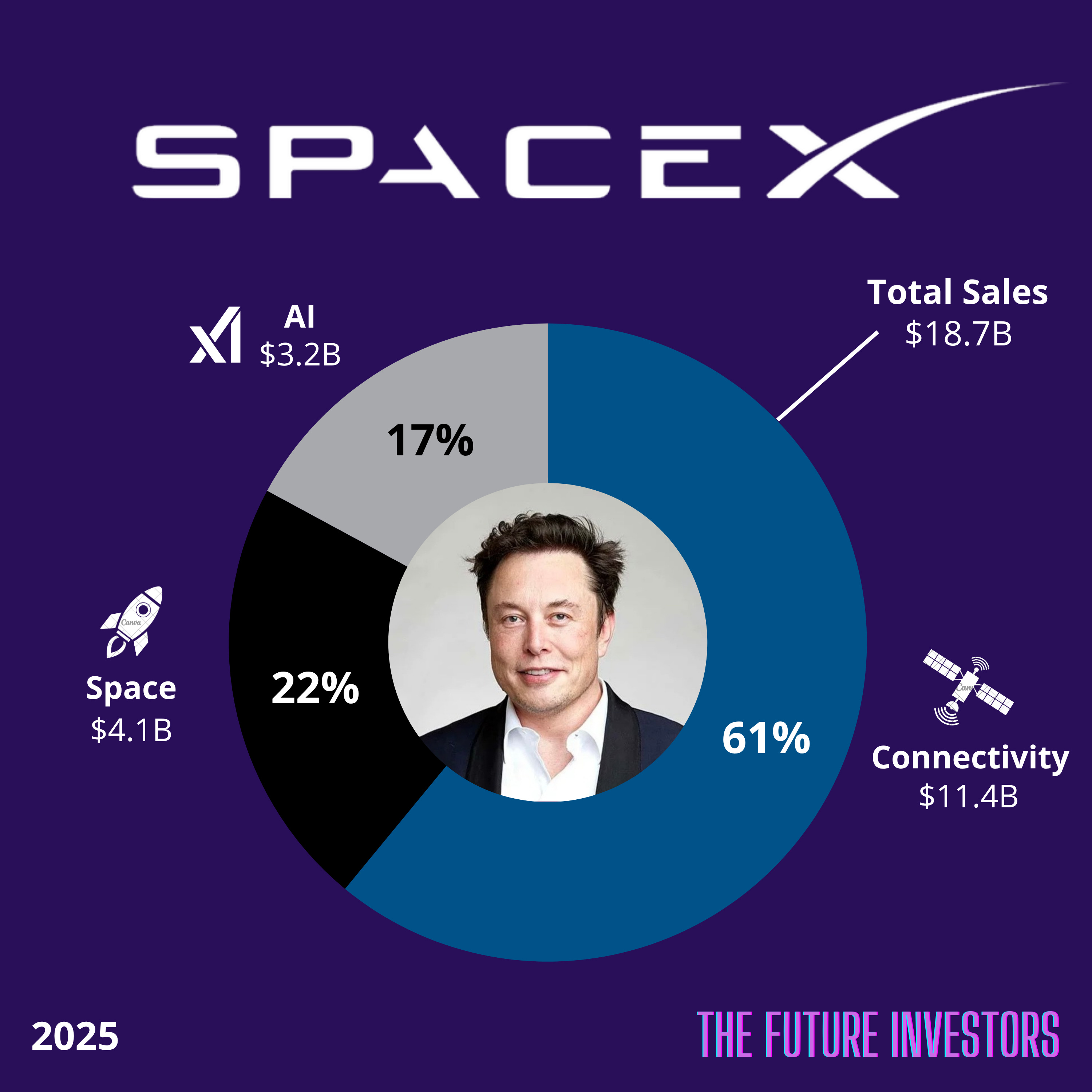
Many investors think of SpaceX as a rocket company. In reality, Starlink generates most of the revenue.
In 2025, revenue came from:
📡 61% Starlink - $11.4 billion
🚀 22% Launch and Space-related activities - $4.1 billion
🤖 17% AI-related services - $3.2 billion
A large part of the investment case depends on Starlink and its future growth.
So what needs to happen for SpaceX to justify its $2.66 trillion valuation?
So far, we’ve explored the numbers behind SpaceX’s $2.66 trillion valuation and where the company’s revenue comes from today.
In the rest of this article, we’ll look at what needs to happen for SpaceX to justify its valuation 🧮, the bull case 🐂, the bear case 🐻, and our view on SpaceX as a long-term investment 📌
This content is exclusively available to our paid subscribers ✨
🔥 Upgrade Now and Save 30%!
Get instant access to this article, our Portfolios & Transactions, our monthly Best Buys, all Deep Dives, all Stock Battles — plus 400+ premium articles to explore!
✅ Already trusted by 4,800+ investors.
🧮 Justifying Today's Valuation
At a valuation of $2.66 trillion, SpaceX is already one of the most valuable companies in the world. The key question is simple:
What does SpaceX need to achieve to justify its valuation?
One way to answer that question is to work backwards from today’s valuation using a reverse discounted cash flow (DCF) model.