


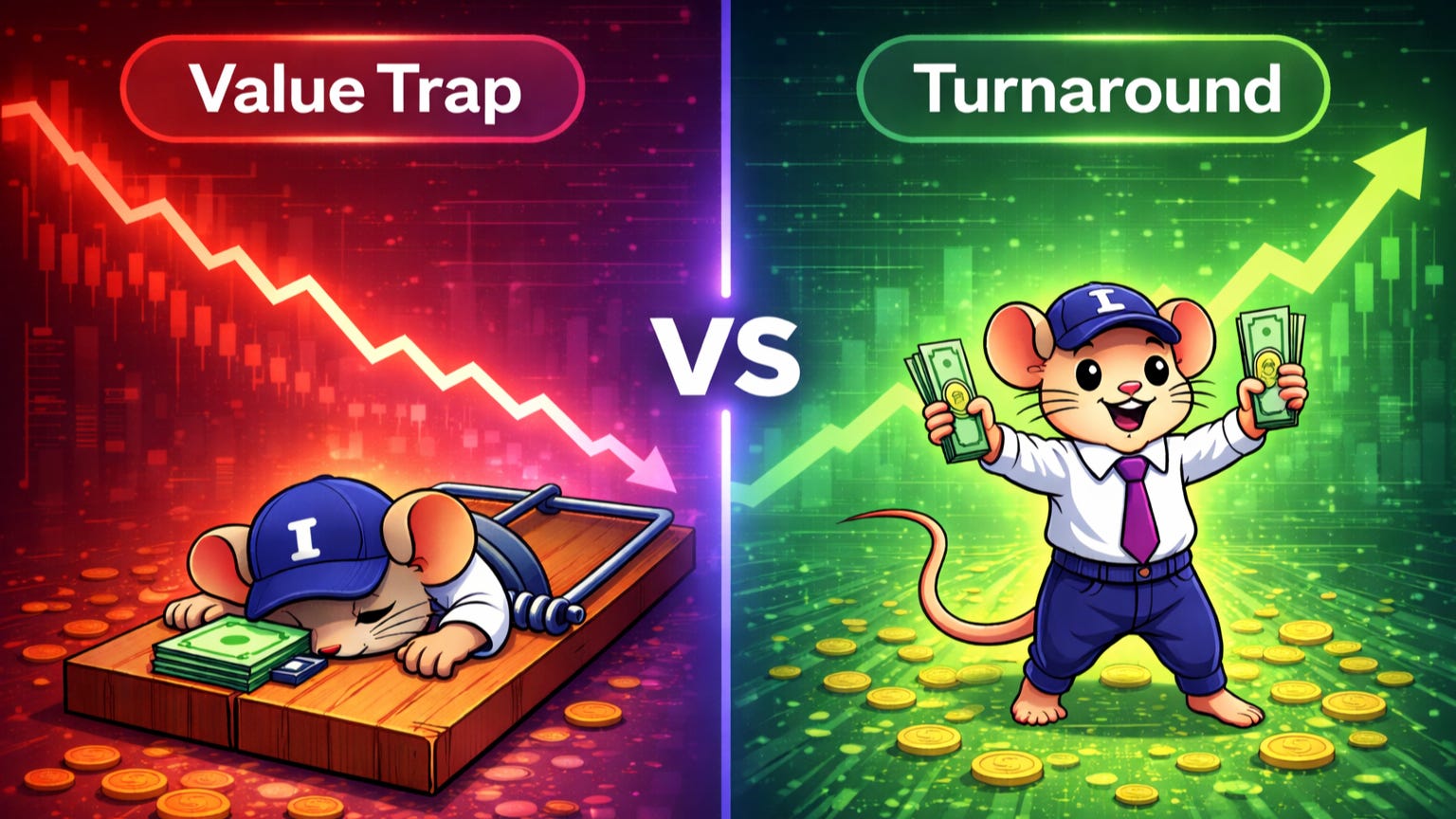
Most investors think they’ve found a bargain when a stock looks cheap, like:
A low P/E
A big drawdown
A company that “used to be great”
It feels like an opportunity. But more often than not… it’s a value trap 🚩
At the same time, some of the best investments start exactly like that — beaten down and overlooked, right before they turn into big winners 🚀
So how do you spot the difference? On the surface, they look the same.
But underneath, the reality is very different.
📉 The Illusion of “Cheap”
A stock doesn’t become cheap by accident. In most cases, the market isn’t wrong, it’s reacting to something real, like:
⏳ Slowing growth
⚔️ Increasing competition
📊 Declining margins
🧩 A broken business model
That’s why many stocks don’t just look cheap… they stay cheap, sometimes for years.
And that’s where investors get trapped. They look at the past, remember what the company used to be, and assume it will go back.
But the market isn’t pricing the past. It’s pricing the future. And if that future doesn’t improve, the stock won’t improve.
Because two stocks can look equally cheap, but for very different reasons. One is broken and getting worse. The other looks broken, but starting to improve. They may look the same… but they’re not.
⚖️ Value Trap vs Turnaround
So how do you actually spot the difference? It comes down to one thing:
Is the business getting better or worse?
Value Trap 🚩
A value trap isn’t just a cheap stock, it’s a business that keeps moving in the wrong direction.
The problems don’t get fixed. In many cases, they get worse over time. Revenue growth slows or turns negative, margins come under pressure, and the company starts to lose market share.
The stock may look attractive. It’s down a lot. Valuation looks low. But the business is not improving. And without real improvement, the story doesn’t change. That’s why it stays cheap.
Turnaround 🚀
A turnaround can look the same at first. The stock is down, sentiment is weak, and valuation looks low.
But here, the direction is starting to change. Revenue begins to stabilize or grow again. Margins improve. The company starts to gain strength again. Management takes the right actions.
These changes are often small at first, but the business is improving and that’s where the opportunity lies.
The Difference That Matters
The biggest difference isn’t valuation. It’s direction. One business is not improving and keeps moving in the wrong direction. The other is improving and starting to move in the right direction. Over time, that difference compounds. And that’s what separates value traps from real opportunities.
🔥 Upgrade Now & Save 30%
Get full access to our Portfolios & Transactions, our Best Buys, all Deep Dives, all Stock Battles — plus 375+ premium articles to explore!
✅ Join 4,500+ investors already inside.
🔍 How to Spot the Difference
If you want to avoid value traps and find real turnarounds, you need to look beyond valuation. Ask yourself the following 3 questions: