


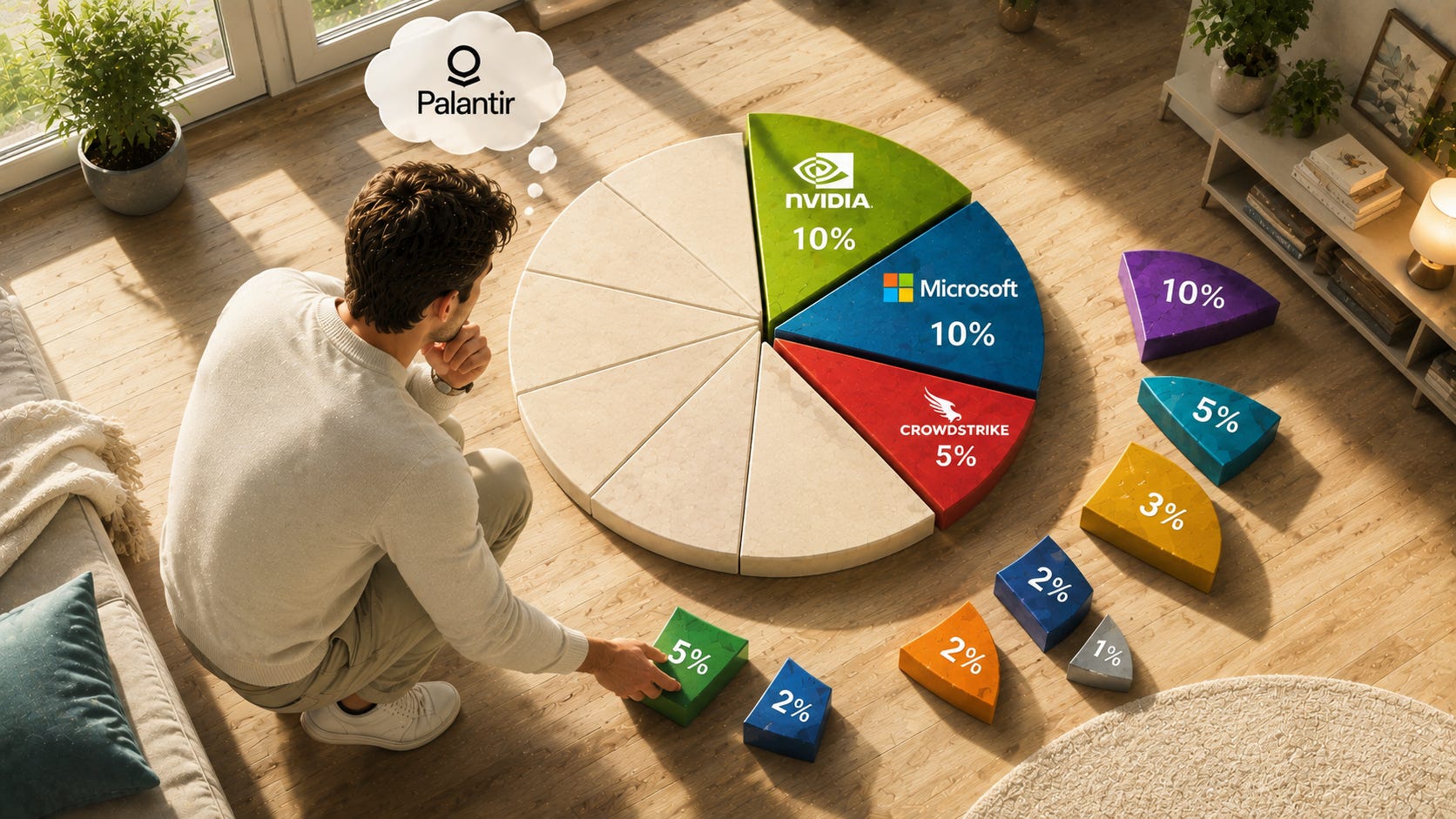
Investors spend a lot of time thinking about which stocks to buy. We analyze growth, financials, valuation, competition and risks. How much of a stock to own gets far less attention, but it is just as important.
So, once you’ve found a company you want to own, the next question is:
How big should the position be?
A stock that doubles may sound like a fantastic investment, but if it makes up only 1% of your portfolio, the impact on your overall return is small. A position that is too large can have a big impact when things go wrong.
There is no perfect percentage that works for every stock. There are different ways to size your positions, based on factors such as conviction, potential upside and risk.
In this article, you’ll learn:
📊 Why position sizing matters
⚖️ The different ways to size your positions
🎯 How to find the right position size
🧩 How we size positions in our portfolios
📊 Why Position Sizing Matters
Position sizing is how much of your portfolio you invest in each stock. In other words, it is about deciding how much capital you want to put behind an investment idea. It has a direct impact on how much a winner — or loser — affects your overall return.
Imagine you have a $100,000 portfolio and one of your stocks doubles:
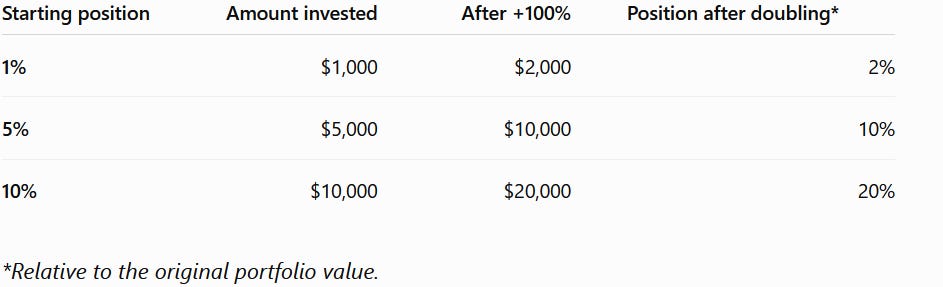
A 1% position that doubles adds only 1% to your portfolio return. A 10% position in that stock adds 10%. The stock delivered a 100% return in both cases, but the impact on your portfolio was very different. A great stock pick can still have little impact on your overall return if the position is too small.
It also works the other way around. If a 10% position falls 50%, it reduces your portfolio by around 5%. If it was only a 2% position, the impact would be around 1%.
The key is finding the right balance:
A position should be large enough to make a difference when you are right, but not so large that one mistake can do too much damage.
Alpha Theory looked at 13 years of data from around 200 equity managers. Their actual portfolios returned 12.5% annually, compared with 8.9% when every position had the same weight. With a more systematic way of sizing positions, returns increased further to 13.7% annually.
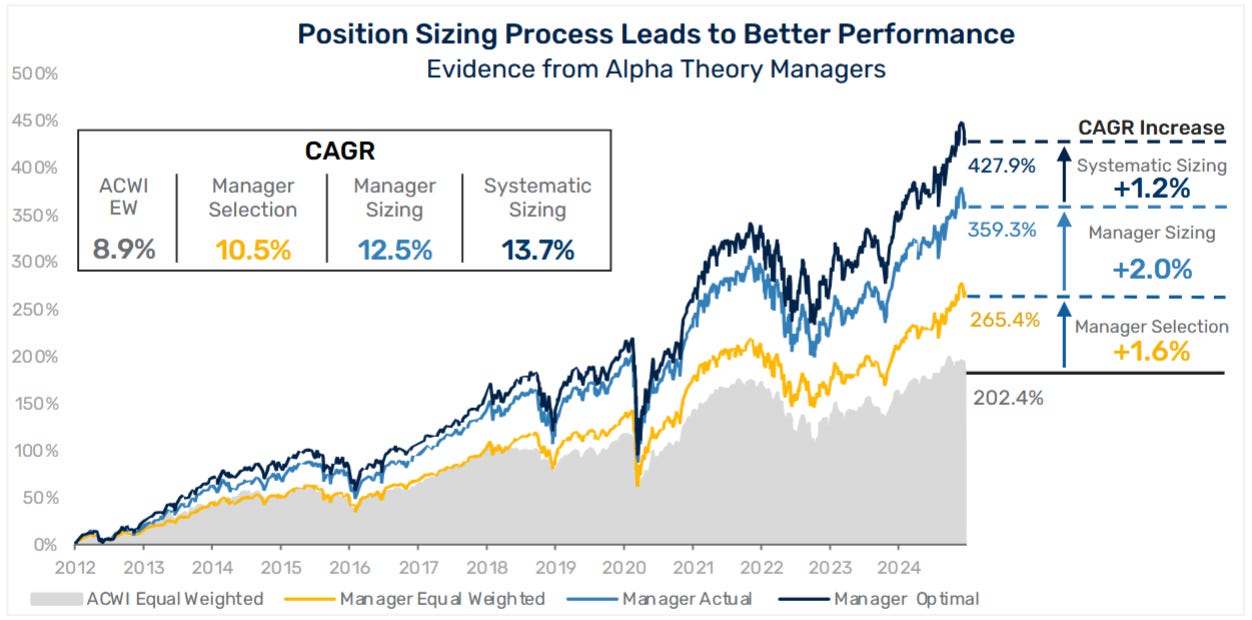
Source: Alpha Theory — Ultimate Position Sizing Guide White Paper
The lesson is clear: what you own matters, but the size of each position matters too.
⚖️ The Different Ways to Size Your Positions
There is no single formula for how big a position should be. You can use different methods, depending on your investment style and how you think about risk and opportunity.
Here are some of the most common ways to size your positions:
Equal Weighting ↔️
Every stock starts with the same position size. If you own 20 stocks, for example, you could allocate 5% to each. It is easy to understand and prevents you from putting too much money into one idea. The downside is that it treats every investment the same, even when your conviction, potential upside or risk may be very different.
Conviction-Based Sizing 💡
The more conviction you have in an investment, the larger the position. Your highest-conviction ideas might get 5–10%, while smaller or more uncertain ideas might start at 1–3%. This gives your best ideas more influence on your portfolio, but conviction alone is not enough. You can have a lot of confidence in a company and still be wrong.
Risk-Based Sizing 🛡️
Here, position size depends on how much risk you see in an investment. A large, profitable company may justify a larger position than a smaller company with an uncertain future. The idea is simple: the more that can go wrong, the more careful you may want to be with the position size.
Upside-Based Sizing 🚀
Another option is to look at the potential return. An investment with attractive upside compared with its downside may deserve a larger allocation than one where the potential return is limited. This also helps connect your research to your portfolio. If you believe one stock offers a much better opportunity than another, should they really have the same position size?
In practice, you don’t have to choose just one method. Conviction, potential upside and risk can all play a role in deciding how much you invest.
But how do you decide what the right position size is?
🔥 Upgrade Now & Save 30%
Get full access to our Portfolios & Transactions, our Best Buys, all Deep Dives, all Stock Battles — plus 425+ premium articles to explore!
✅ Join 4,800+ investors already inside.
🎯 How to Find the Right Position Size
So, how do you decide if a stock should be 2%, 5% or perhaps 10% of your portfolio?
You can make this decision easier by looking at three key factors:
Conviction 💡
How strong is your investment thesis? The better you understand the company, its business and the reasons you own it, the more comfortable you may be with a larger position. But conviction should never be confused with certainty.
Potential Upside 🚀
How attractive is the opportunity at the current price? A great company is not always a great investment at any price. If you see significant upside from current levels, there may be more reason to give the stock a larger position.
Risk 🛡️
What could go wrong? A company with an uncertain business model, weak balance sheet or high execution risk may deserve a smaller position. The more risk you see, the more careful you may want to be with how much you invest.
Instead of choosing a different percentage for every stock, you can also work with position size ranges. For example:
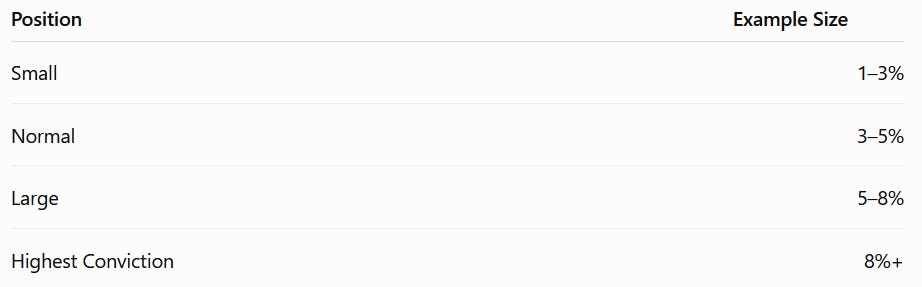
These percentages are only an example. The right ranges depend on factors such as the number of stocks you own and how much risk you are comfortable taking. The important part is having a clear framework for your sizing decisions.
It also gives you a useful question to ask when looking at your portfolio:
Do your best investment ideas also have the largest positions?
If one of your highest-conviction ideas is only a small position, it is worth asking why. Your portfolio should reflect where your strongest investment ideas are.
If one of your strongest ideas is only 1% of your portfolio, it may have little impact even if your thesis turns out to be right. At the same time, a 10% position deserves a much higher level of confidence because getting it wrong will have a much bigger impact.
Position sizing is not about finding one perfect percentage. It is about matching the size of a position with your conviction, potential upside and risk.
🧩 How We Size Positions in Our Portfolios
In our portfolios, we use a combination of conviction, potential upside and risk when deciding how much we want to invest in a stock. But above all, the fundamentals of the company are at the center of our decisions.
A high-conviction idea does not automatically get a large position. A company with more execution risk, for example, will usually get a smaller position. Even if the potential upside is high, we want the position size to reflect the risk that things do not go as planned. We also look beyond the individual stock. If several positions are exposed to the same risks or trends, we take that into account when deciding how much capital we want to invest.
Valuation also matters. We can have a lot of conviction in a company, but if the stock is priced for perfection, we are less likely to add more capital. That does not mean we automatically sell or trim it. As long as the fundamentals remain strong and our thesis is intact, we are comfortable letting a winner run.
This brings us to another important part of our strategy: the difference between how much we invested and how large a position has become.
Imagine we invest 5% of our portfolio in a stock and the stock triples. That original investment is now worth 15% of our starting portfolio value. That does not automatically mean the position is too large or that we should sell.
The opposite can happen with a losing position. If we invest 5% and the stock falls 50%, it is now worth around 2.5% of our starting portfolio value. That does not automatically mean we should bring it back to 5%.
This is something Peter Lynch famously described as:
“Selling your winners and holding your losers is like cutting the flowers and watering the weeds.”

Source: Illustration created with AI. Quote by Peter Lynch.
That is exactly what we want to avoid. A smaller position is not automatically a reason to buy more, just as a larger position is not automatically a reason to sell.
This is why we pay close attention to how much capital we have invested, not only the current weight of a position. Every time we consider adding, we take a fresh look at the fundamentals, valuation, potential upside and risk. A lower stock price or smaller position alone is never a reason for us to buy more.
Of course, current position size still matters. If one stock becomes a very large part of the portfolio, the risk increases and trimming can make sense. But for us, there is an important difference between a position that becomes large because the stock performed well and one that is large because we kept adding more capital.
This gives our winners room to grow, while keeping our focus on the fundamentals, valuation and risk.
📌 Key Takeaways
Position sizing plays an important role in your portfolio returns. A great stock can have little impact if the position is too small, while a position that is too large can hurt when things go wrong.
There is no perfect position size. The right size depends on factors such as conviction, potential upside and risk.
📊 Size matters: Even a big winner will have little impact if the position is too small.
⚖️ Balance risk and opportunity: Larger positions can have a bigger impact, both positive and negative.
🎯 Make your portfolio reflect your ideas: Your strongest investment ideas should have enough weight to make a difference.
🌱 Give winners room to grow: A larger position is not automatically a reason to sell, and a smaller position is not automatically a reason to buy more.
The goal is not to find the perfect percentage, but to give your best ideas enough weight to matter without putting too much of your portfolio at risk.
Thank you for reading! 🙏
We put a lot of love into creating this post for you. If you enjoyed it, feel free to click the ❤️ button so more people can discover it on Substack or hit the ↪️ share button to share it with friends, family and fellow investors!
Don’t hesitate to share your thoughts in the comments — we’d love to hear from you 💬
That’s it for today.
We’ll see you again in the next edition of our newsletter!
Until then, invest wisely.
Vincent & Stefan
The Future Investors
Disclaimer:
The information and opinions provided in this article are for informational and educational purposes only and should not be considered as investment advice or a recommendation to buy, sell, or hold any financial product, security, or asset. The Future Investors does not provide personalized investment advice and is not a licensed financial advisor. Always do your own research before making any investment decisions and consult with a qualified financial professional before making any investment decisions. Please consult the general disclaimer for more details.