


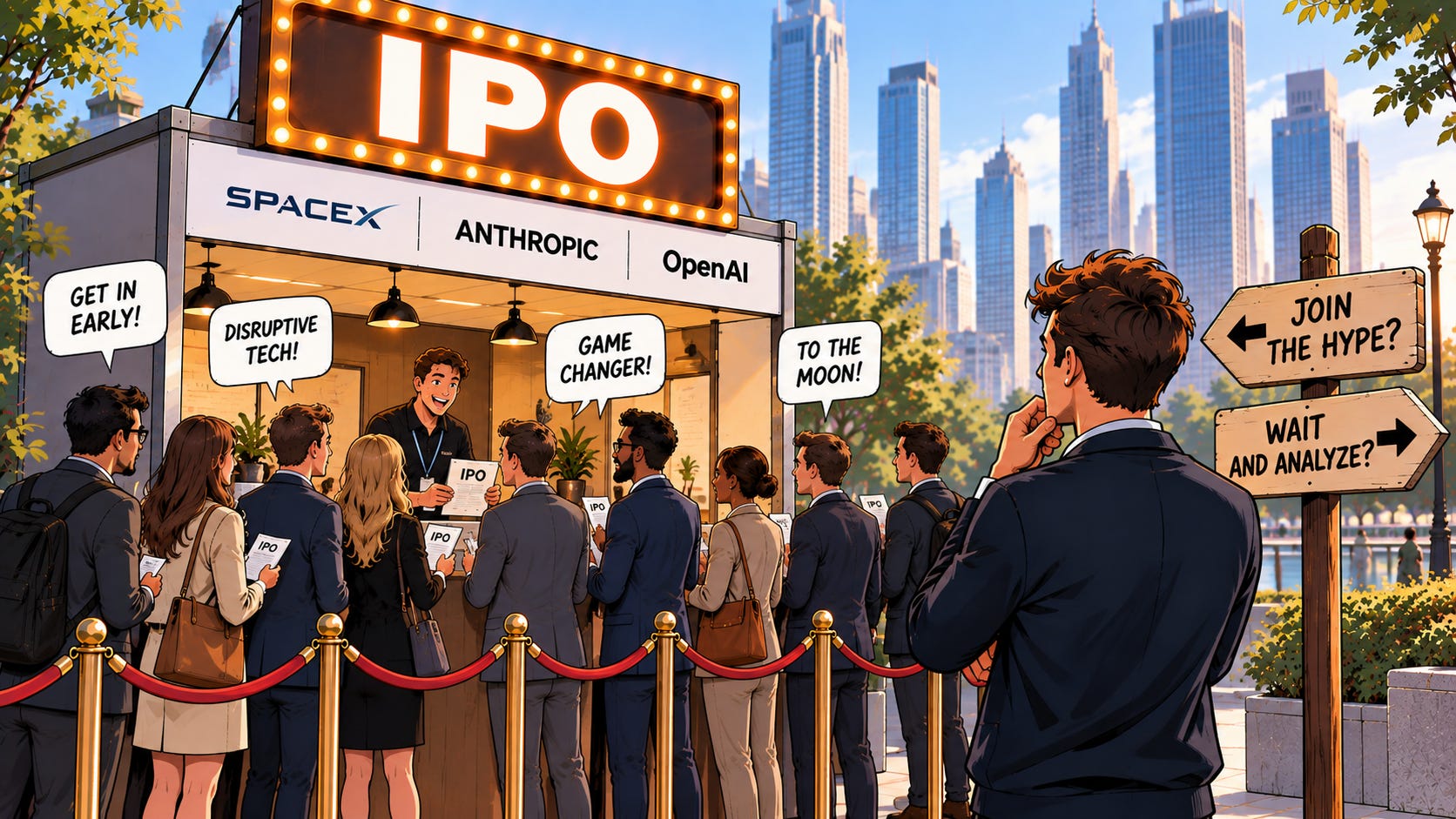
Some of the world’s most exciting companies stay private for years. Then, when they go public, investors finally get the chance to buy the stock.
We recently saw this with SpaceX. Companies like Anthropic and OpenAI are also making plans for potential IPOs in the near future.
That usually creates a lot of excitement. But buying a newly listed stock is different from buying a company that has already been public for years. The pricing works differently, insiders may still be locked up, and the first weeks of trading can be very volatile.
So the key question is:
Should you buy the IPO, or is it better to wait?
In this article, you’ll learn:
🏛️ How an IPO works
🔥 Why IPOs can get expensive
⏳ What happens after the IPO
📊 What history tells us about IPO returns
🎯 When is the right time to buy?
🏛️ How an IPO works
An IPO, or Initial Public Offering, is the moment a private company becomes publicly traded and its shares become available to investors on a stock exchange.
Companies usually go public for a few reasons: to raise capital for growth, give founders and early investors a way to sell their shares, and increase the company’s visibility.
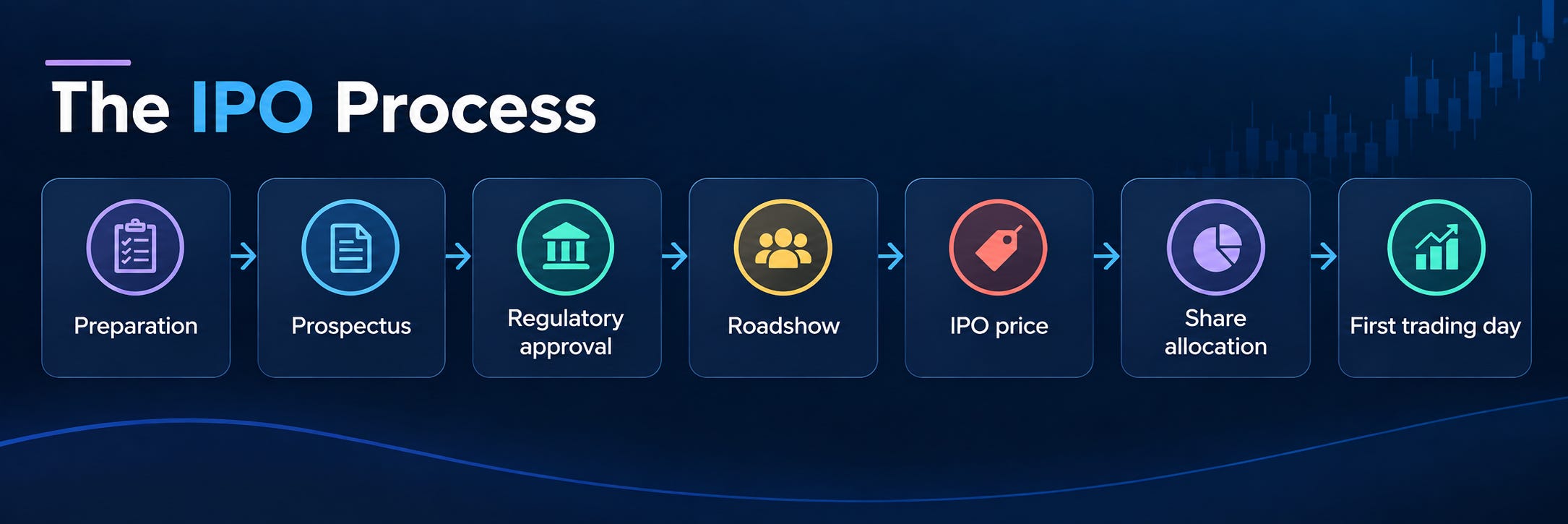
Before the stock starts trading, the company goes through several steps. It hires investment banks, accountants and lawyers, prepares a detailed prospectus with its financials and risks, and files the required documents with the regulator. The company also chooses which stock exchange it wants to list on, such as the Nasdaq or NYSE, and a ticker symbol that investors will use to find and trade the stock.
Next comes the roadshow, where management presents the company to large investors. Based on investor demand, the company and its investment banks set the final IPO price and decide how the shares will be allocated.
The process usually looks like this:
Source: The Future Investors, based on SEC and NYSE IPO guidance
Not all shares sold in an IPO are necessarily new shares. Some are primary shares, where the money raised goes to the company. Others can be secondary shares, sold by existing shareholders such as founders or early investors.
Want to see how an IPO works in practice? This short CNBC video explains the process using Snap as an example 🎥👇
🔥 Why IPOs Can Get Expensive
One important thing to understand is that the IPO price itself says very little about how expensive a stock is. A company may price its IPO at $30 per share, but the company can already have a very high valuation at that price. It depends on things like the number of shares outstanding, the company’s revenue, earnings, growth and how much investors are willing to pay for that growth.
Before trading starts, IPO shares are often allocated to institutional investors, such as investment funds and large asset managers. Retail investors may get limited access, or no access at all, to the official IPO price.
If demand is strong, the stock could then open at $45. That is a 50% jump from the IPO price before many retail investors even get the chance to buy. This is called the IPO pop.
Newly listed stocks can also trade at a high valuation because only a limited number of shares may be available for trading at first. Once the stock starts trading publicly, retail investors can also start buying. If a lot of investors want the stock at the same time, there can be more buyers than shares available. This can push the share price higher in a short time. And when the price starts rising, FOMO can attract even more retail investors, pushing the valuation higher.
🔥 Upgrade Now & Save 30%
Get full access to our Portfolios & Transactions, our Best Buys & Rising Stars, all 15+ Deep Dives, all 95+ Stock Battles — plus 430+ premium articles to explore!
✅ Join 4,800+ investors already inside.
⏳ What Happens After the IPO
Going public is only the beginning. After the IPO, investors start getting much more information about the company and how it performs as a public business.
One of the first important moments is the first earnings report. Investors can then compare the company’s actual revenue, margins and growth with the expectations around the IPO.
The first weeks and months can also be very volatile. Only part of the company’s shares may be available for trading, and investors are still trying to find a fair price for the stock. More analysts also start following the company, which gives investors more earnings estimates and valuation models to compare.
Another important event is the lock-up period. Founders, employees and early investors are often not allowed to sell all their shares directly after the IPO. This period is often around 180 days, but it can be shorter or longer. When the lock-up ends, more shares can become available for trading. If many insiders decide to sell, the extra supply can put pressure on the stock price.
Over the next few quarters, investors get a much better picture of the company. They can see if management delivers on its plans, how margins develop, how much cash the company generates and if growth continues. The longer a company has been public, the more information you have as an investor to judge the business and its valuation.
📊 How Do IPOs Perform?
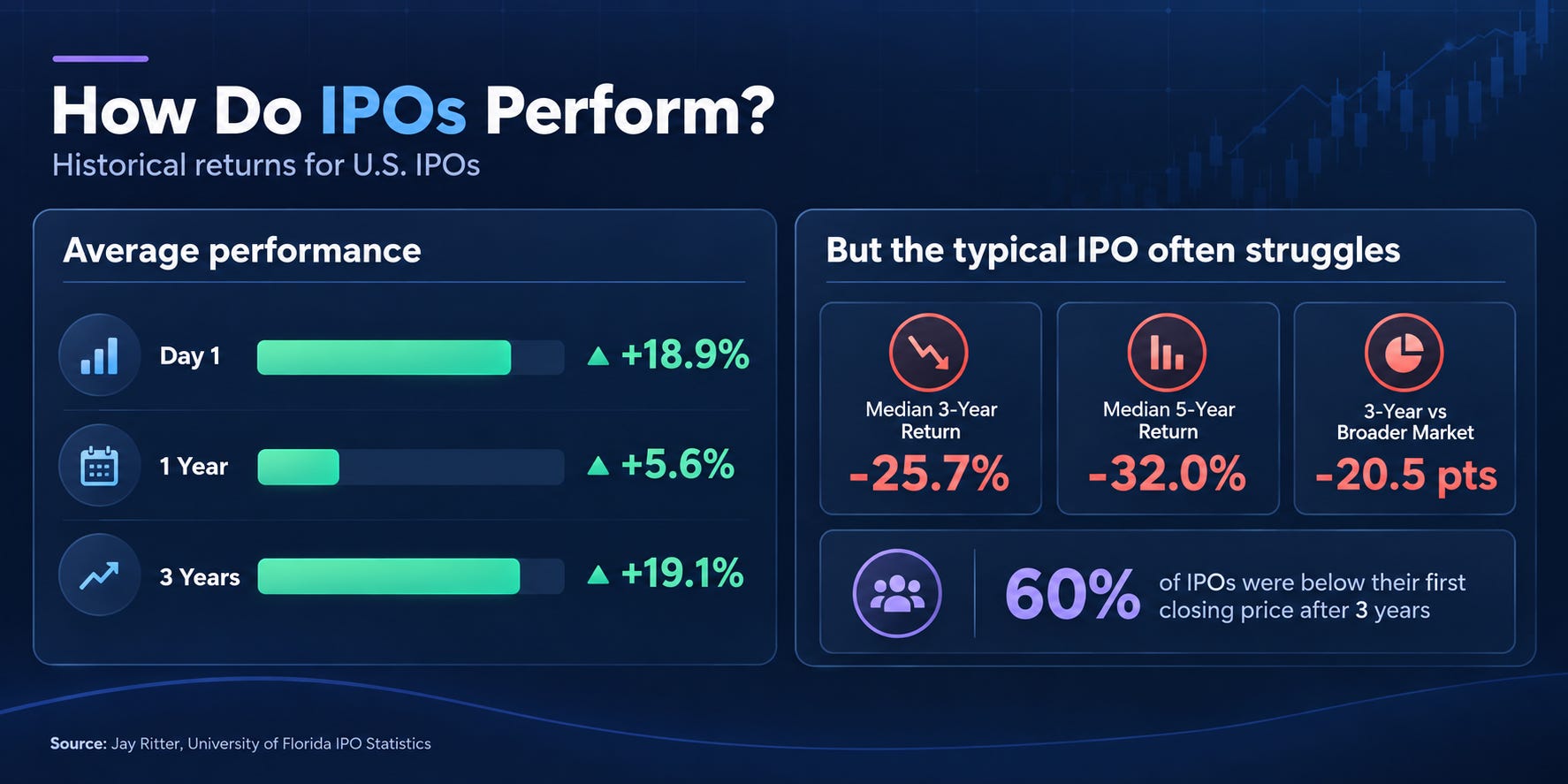
IPOs get a lot of attention because of the jump on the first trading day. Across more than 9,000 U.S. IPOs from 1980 to 2024, the average first-day return was +18.9%. After that, the picture looks very different.
From the first closing price, IPOs returned an average of +19.1% over three years. That sounds positive, but the broader U.S. market returned +39.6% over the same period, a gap of 20.5 percentage points.
The median results were much weaker. Looking at IPOs from 1975 to 2021, the median three-year return was -25.7%. Around 60% of IPOs were below their first closing price after three years, and 38.5% had lost more than half their value.
After five years, the median return was -32.0%. A small group of very big winners helped push the average higher, but many IPOs struggled.
Source: Jay Ritter, University of Florida IPO Statistics
One important detail: the +18.9% first-day return is measured from the official IPO price. Many retail investors cannot buy at that price and only get access once the stock starts trading.
So there is a big difference between the IPO pop on Day 1 and the returns investors may see in the years after.
🎯 When Is the Right Time to Buy?
Investors sometimes joke that IPO stands for “It’s Probably Overpriced.” That is not always true, but as we saw in the previous chapter, the excitement around an IPO does not always lead to strong returns in the years that follow.
There is no single perfect moment to buy a newly listed stock. But for long-term investors, there is usually no need to rush on the first trading day.
The first days after an IPO can be driven by excitement, limited share supply and FOMO. You still have very little public information about how the company performs as a listed business. There is also no rule that says you should wait three or six months. What matters more is the valuation compared with the company’s expected future growth.
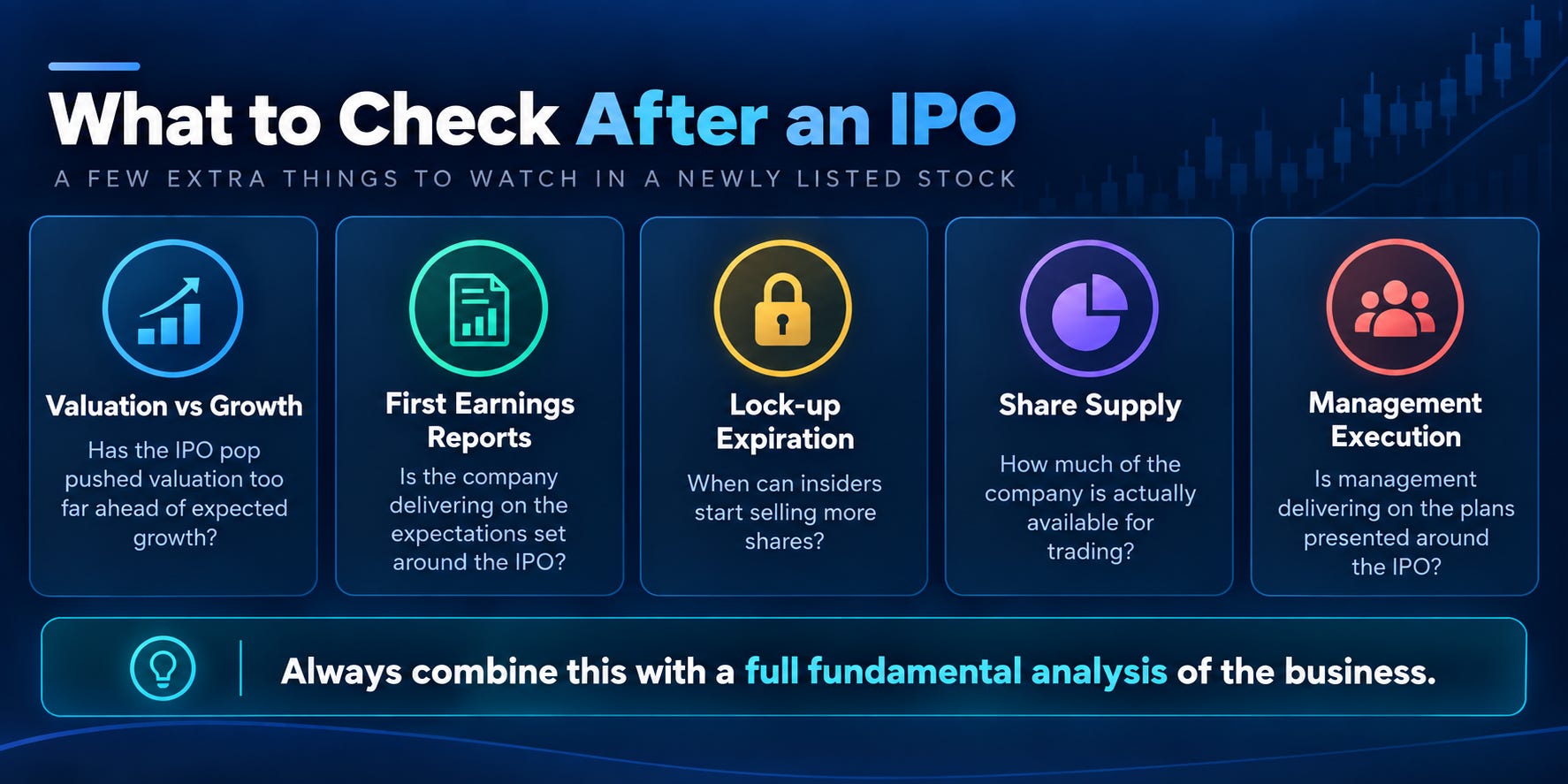
As with any stock, you should always do a full fundamental analysis of the business, including its growth, margins, cash flow, the market, management and valuation.
With a newly listed company, there are also a few extra things to watch. Look at the first earnings reports, the lock-up period, how many shares are actually available for trading and if management is delivering on the plans presented around the IPO.
Source: The Future Investors
A fast-growing company can deserve a higher valuation. But if the stock price rises much faster than revenue and earnings expectations, you may be paying too much for that future growth.
Waiting for one or more earnings reports can help. You get more information about the business and can see if management is delivering on the growth investors expected at the IPO.
Some IPOs may already offer an attractive valuation versus growth soon after listing. Others may stay expensive for much longer.
So instead of asking “How long should I wait?”, ask:
“Is the expected growth over the coming years strong enough to justify the valuation I am paying?”
Thank you for reading! 🙏
We put a lot of love into creating this post for you. If you enjoyed it, feel free to click the ❤️ button so more people can discover it on Substack or hit the ↪️ share button to share it with friends, family and fellow investors!
Don’t hesitate to share your thoughts in the comments — we’d love to hear from you 💬
That’s it for today.
We’ll see you again in the next edition of our newsletter!
Until then, invest wisely.
Vincent & Stefan
The Future Investors
Disclaimer:
The information and opinions provided in this article are for informational and educational purposes only and should not be considered as investment advice or a recommendation to buy, sell, or hold any financial product, security, or asset. The Future Investors does not provide personalized investment advice and is not a licensed financial advisor. Always do your own research before making any investment decisions and consult with a qualified financial professional before making any investment decisions. Please consult the general disclaimer for more details.
I think in general its just best to steer away from IPOs. So many other options in the market. The numbers don't lie