



In the stock market, there are many companies growing their revenue at impressive rates. Some grow by 20% per year. Others by 30%, 40% or even 50%.
At first, many of these companies look very similar. They are growing fast, serve large markets and attract a lot of attention from investors. But if we look ten or twenty years ahead, the outcome is often very different.
A small number of companies become legends. Companies like Nvidia, Amazon, Visa and MercadoLibre continue to grow, strengthen their position and create significant value for shareholders.
But most others become memories. Despite growing fast today, many of these companies will struggle to keep growing, lose their competitive edge, get acquired or simply disappear over time.
So what makes the difference?
Why do some companies become legends 🏆 while others become memories? 🕰️
In this article, we’ll break down:
📈 Why growth is only the beginning
🏰 What separates legends from memories
🚀 Three examples of companies that turned growth into greatness
🔍 How you can identify future legends
📈 Why Growth Is Only The Beginning
When investors analyze a company, growth is often one of the first things they look at. And for good reason. A company growing its revenue by 30% per year is usually far more attractive than a company growing by just 5%.
But there is a problem: growth alone isn’t enough.
Imagine two companies:
🏢 Company A: Revenue growth 35%
🏢 Company B: Revenue growth 25%
Based on those numbers alone, many investors would probably choose Company A. After all, faster growth sounds better. But that doesn’t always make it the better investment.
Perhaps Company A is growing because it is lowering prices, spending heavily on marketing or benefiting from a short-term trend. Company B might be growing because customers love its product, keep coming back and recommend it to others.
Today, Company A may look more attractive. But ten years from now, the outcome could be completely different.
This is a mistake many investors make. They focus on how fast a company is growing, while the more important question is often: “Why is this company growing?”
A company can grow quickly for a few years without building anything special. Another company can use that same growth to strengthen its position, attract more customers and create advantages that competitors struggle to match.
Growth may help a company get noticed. But growth alone doesn’t make a company a legend.
To answer that question, we need to look at what separates legends 🏆 from memories 🕰️
🏰 What Separates Legends From Memories
If growth alone doesn’t explain why some companies become legends, what does?
The best companies don’t just grow. They become stronger as they grow.
More customers, more products and more revenue help strengthen their position. As a result, it becomes harder for competitors to challenge them. This is what we call a moat: a competitive advantage that helps a company stay ahead of its competitors.
A moat is not something that appears overnight. It needs to be built over time.
The most successful companies use growth to build that moat. Every new customer, product launch or expansion helps strengthen their competitive position.
Companies build moats in different ways. According to Morningstar, most moats can be grouped into five categories:
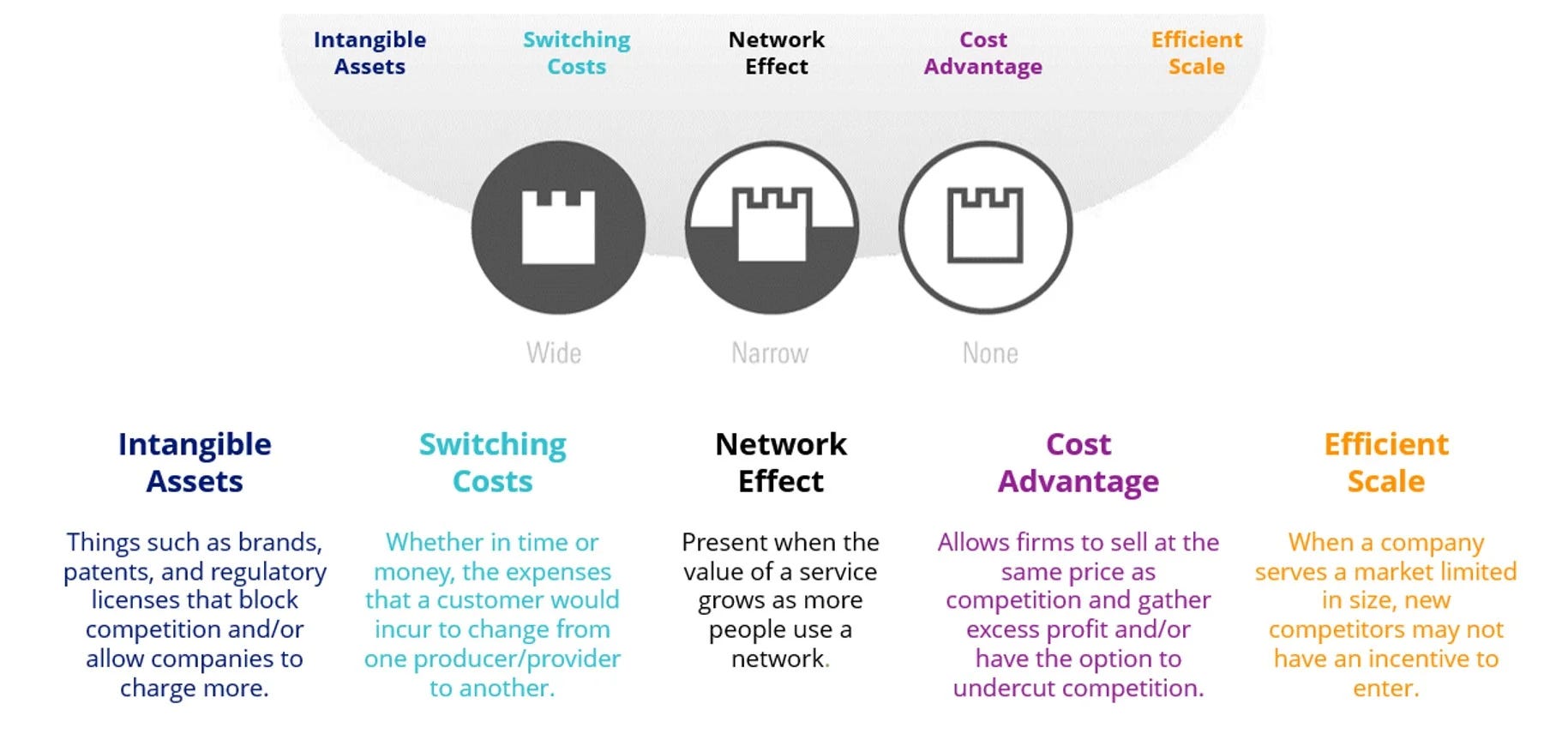
Source: 5 Sources of Moats - Morningstar
📜 Intangible Assets
Strong brands, patents, licenses or unique intellectual property that competitors cannot easily replicate.
🔒 Switching Costs
When changing to another product or service becomes expensive, time-consuming or inconvenient for customers.
🌐 Network Effects
The product becomes more valuable as more people use it.
💰 Cost Advantages
Companies can operate more efficiently than competitors, helping them offer lower prices or earn higher profits.
🏗️ Efficient Scale
A market is only large enough for a few players, making it difficult for new competitors to enter.
While these advantages may look different, they all have one thing in common:
They make the business harder to compete against.
Companies that become memories often follow a different path. They may grow quickly for a few years and attract plenty of attention from investors. But they fail to build a moat.
Without a strong competitive advantage, competitors can copy their products, match their prices or offer a similar service. As competition increases, growth slows and the business becomes weaker. In other words, these companies grow bigger, but they don’t become stronger.
Many companies grow. The best companies use that growth to build a moat.
That moat is often what turns a company into a legend 🏆 instead of a memory 🕰️
Want to learn more about moats? 🏰
In this short video, Warren Buffett and Charlie Munger explain why strong competitive advantages matter 🎥👇
🔥 Upgrade Now & Save 30%
Get full access to our Portfolios & Transactions, our Best Buys, all Deep Dives, all Stock Battles — plus 400+ premium articles to explore!
✅ Join 4,800+ investors already inside.
🚀 Three Examples of Growth Into Greatness
Now that we understand what separates legends from memories, let’s look at three companies that used growth to build powerful moats.
These companies didn’t become legends because they grew fast.
They became legends because their growth made the business stronger.
Let’s look at three examples.
1️⃣ Visa — Network Effects 🌐
Visa is one of the best examples of a company that became stronger as it grew.
Every new cardholder makes Visa more attractive for merchants. And every new merchant makes Visa more valuable for cardholders. This creates a powerful network effect.
Today, billions of Visa cards are used around the world and millions of businesses accept Visa payments. Visa didn’t just use growth to get bigger. It used growth to build one of the strongest moats in the world.
2️⃣ Nvidia — Intangible Assets 📜 & Switching Costs 🔒
Nvidia’s success is about much more than selling chips. The company built a powerful software ecosystem around CUDA, its AI development platform. Today, millions of developers and companies use Nvidia’s tools to build AI applications. This creates strong switching costs.
Nvidia has also spent decades building unique technology, software and expertise. These advantages are difficult for competitors to replicate. As Nvidia grew, its moat grew with it. It didn’t just sell more chips. It used growth to build an ecosystem that is difficult to compete with.
3️⃣ MercadoLibre — Network Effects 🌐 & Efficient Scale 🏗️
MercadoLibre started as an online marketplace in Latin America. Today, it offers e-commerce, payments, logistics, advertising and financial services. As more buyers join the platform, more sellers are attracted. And as more sellers join, the platform becomes even more valuable for buyers. This creates a strong network effect.
MercadoLibre has also built one of the largest logistics and payments networks in Latin America. This creates efficient scale and makes it harder for competitors to compete. Growth helped MercadoLibre build a wider moat and strengthen its market leadership.
These three companies operate in different industries. But they all followed the same path: They didn’t just use growth to get bigger. They used growth to become stronger.
🔍 How To Identify Future Legends
We’ve seen what made companies like Visa, Nvidia and MercadoLibre successful. The next question is: How can you identify future legends?
There is no perfect formula. But many legendary companies have a few things in common.
1️⃣ Does growth make the business stronger?
This is often the most important question.
Every time Visa gains a new user, its network becomes more valuable.
Every time MercadoLibre adds a new buyer or seller, its ecosystem becomes stronger.
Every time Nvidia sells more AI chips, more developers use CUDA.
Ask yourself:
Does growth make this business stronger, or does it simply make it bigger?
2️⃣ Is the company building a moat?
Look for signs such as:
📜 Intangible Assets
🔒 Switching Costs
🌐 Network Effects
💰 Cost Advantages
🏗️ Efficient Scale
The stronger the moat becomes, the harder it is for competitors to challenge the company.
3️⃣ Can competitors easily copy the business?
Many companies grow quickly. Far fewer companies build something that is difficult to replicate. Ask yourself:
If a competitor had unlimited money, could they realistically build the same business?
For companies like Visa, Nvidia or ASML, the answer is far from simple. That is exactly what makes them special.
4️⃣ Will this company be stronger in 10 years?
The stock market often focuses on the next quarter. Long-term investors should think differently. Ask yourself:
Will this company have a stronger position in ten years?
And another important question:
Will this market be much larger in ten years?
The best investments often combine a company that is building a moat with a powerful long-term trend.
🎯 Key Takeaway
Many investors focus on finding the fastest-growing companies. But growth alone rarely tells the full story.
The best companies use growth to strengthen their position, build a moat and make it harder for competitors to compete.
That is why some companies become legends while others become memories.
The best investors don’t just look for growth. They look for companies that use growth to build a moat.
Because growth alone rarely creates a legend. Building a strong moat does 🏆
Thank you for reading! 🙏
We put a lot of love into creating this post for you. If you enjoyed it, feel free to click the ❤️ button so more people can discover it on Substack or hit the ↪️ share button to share it with friends, family and fellow investors!
Don’t hesitate to share your thoughts in the comments — we’d love to hear from you 💬
That’s it for today.
We’ll see you again in the next edition of our newsletter!
Until then, invest wisely.
Vincent & Stefan
The Future Investors
Disclaimer:
The information and opinions provided in this article are for informational and educational purposes only and should not be considered as investment advice or a recommendation to buy, sell, or hold any financial product, security, or asset. The Future Investors does not provide personalized investment advice and is not a licensed financial advisor. Always do your own research before making any investment decisions and consult with a qualified financial professional before making any investment decisions. Please consult the general disclaimer for more details.