



Most investors think their biggest investing mistake will be buying the wrong stock. A company with slowing growth. A stock that falls 80%. A business that disappoints quarter after quarter.
But in reality, the biggest mistake is often something completely different:
Selling a great company too early.
Almost every long-term investor has a painful story like this:
🗣️ “I bought Nvidia at $40… and sold at $90.”
🗣️ “I owned Amazon at $60… but sold after it doubled.”
🗣️ “If I had just held that stock, I’d be a millionaire today.”
At the time, selling felt smart. The stock had already doubled, the valuation looked high, and taking profits felt disciplined and responsible.
But many of the biggest investing mistakes started with exactly that decision.
Because the biggest returns in investing often don’t come in the first few years.
They come later, when compounding becomes much more powerful.
In this article, we’ll break down:
🧠 Why investors sell winners too early and hold losers too long
⏳ Why compounding becomes so powerful over time
💰 When selling actually makes sense
Let’s start with a simple question:
Why do investors sell great companies too early?
🧠 Why Investors Sell Winners Too Early
Investing is not just about numbers and valuation models. It’s also about psychology.
Why do investors often sell their winners too early while holding their losers for too long?
The answer lies in how the human brain works. The brain naturally wants to protect profits and avoid pain. That’s why many investors start thinking differently once a stock doubles or triples. The focus shifts from future upside to what they could lose.
Many investors also start questioning the company and looking for reasons why the stock may fall:
🗣️ “Can this company really keep growing?”
🗣️ “Maybe the best years are behind it.”
🗣️ “What if this is the top?”
🗣️ “Maybe I should take some profits.”
Emotionally, selling feels right. It feels smart, disciplined, and responsible. A stock that already went up 300% starts feeling expensive, risky, and too high, even when the business itself is performing better than ever.
Investors react very differently to losing positions. When a stock falls 60% or 70%, many investors convince themselves the stock is now “cheap” and keep holding, hoping it eventually recovers.
Peter Lynch described this perfectly:
“Selling your winners and holding your losers is like cutting the flowers and watering the weeds.”
Selling a losing investment means accepting that you were wrong. Emotionally, that is very difficult.
That’s why many investors prefer taking profits quickly while holding losing positions for much longer. But the stock market often works the other way around. Weak companies often continue getting weaker, while great companies continue getting stronger.
That’s what makes investing psychologically difficult. Investors become more fearful as great companies rise… and more optimistic as weak companies fall.
Selling often feels intelligent, while holding often feels uncomfortable.
Peter Lynch talked about this many times in the past. In the video below, he explains how even he sold great companies too early, and later realized it was a mistake. 🎥👇
⏳ The Power of Compounding
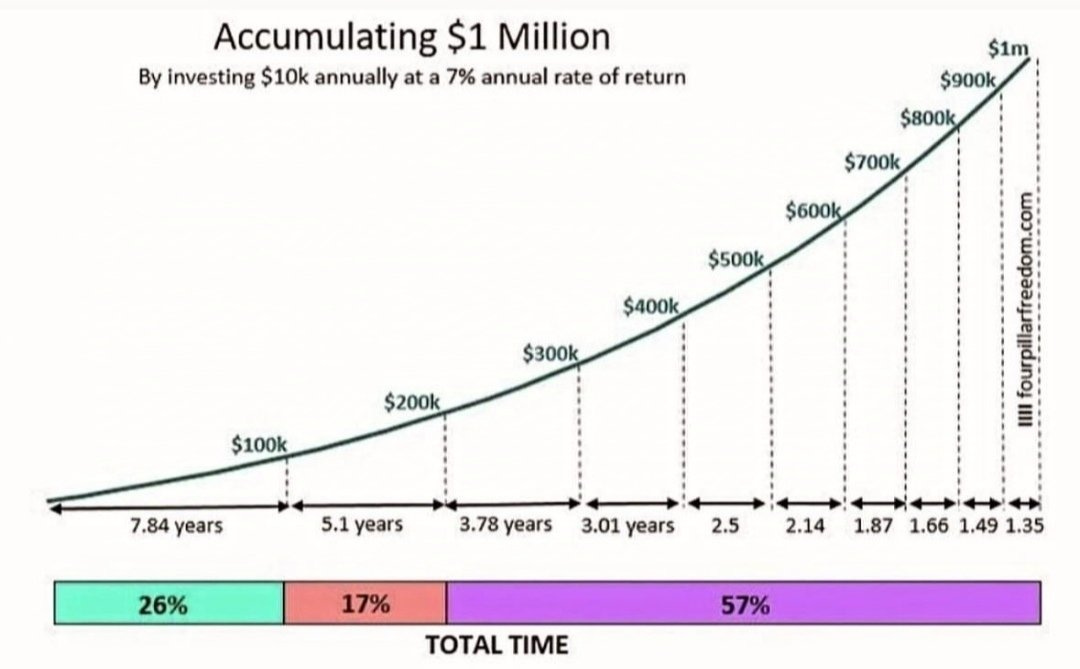
The biggest returns in investing often don’t come in the beginning. They usually come much later. That’s because compound interest looks slow at first… but becomes incredibly powerful over time. Albert Einstein even called it the “eighth wonder of the world.”
A company growing at 20% per year doubles in around 4 years, becomes 6x larger in 10 years, and almost 40x larger in 20 years. And that’s exactly why selling great companies too early can become so expensive.
Most investors never experience the most powerful phase of compounding because they sell years too early. Or as Charlie Munger once said:
“The first rule of compounding: never interrupt it unnecessarily.”
The chart below shows why compounding becomes so powerful over time. In the beginning, growth looks relatively slow. But later, growth becomes much faster and more powerful. That’s why patience is so important in investing.
Source: Four Pillar Freedom Blog
Many investors think a stock that already went up a lot can no longer outperform. But history often shows otherwise. Companies like Amazon, Nvidia, Apple, and ASML looked “expensive” many times during their rise. But they kept growing for years because the businesses became stronger over time, with larger moats, scale advantages, pricing power, and growing cash flows. That’s one of the reasons why some of the best companies keep outperforming for far longer than most investors expect.
One of the most powerful things about investing is that your downside is limited, while your upside can be enormous. A stock can only fall 100%. But a great company can rise 500%, 1,000%, 5,000%, or even more over long periods of time. That asymmetry is incredibly powerful.
Just one exceptional investment can completely change the returns of an entire portfolio. A stock falling 50% needs to rise 100% just to break even. But a stock rising 1,000% can easily outweigh many smaller mistakes and losses.
The longer time and compounding can do their work, the bigger the impact becomes. A stock rising another 20% after already gaining 1,000% may not sound very impressive at first. But that extra gain can create more wealth than all the earlier years combined.
That’s why many of the biggest fortunes in investing were not built through constant trading. They were built through patience, time, and uninterrupted compounding.
🔥 Upgrade Now & Save 30%
Get full access to our Portfolios & Transactions, our Best Buys, all Deep Dives, all Stock Battles — plus 400+ premium articles to explore!
✅ Join 4,700+ investors already inside.
💰 When Should You Sell?
So does this mean you should never sell a stock? Not at all. Sometimes, selling is absolutely the right decision. But as an investor, you should be very critical before selling a great company.
Just because a stock went up a lot doesn’t mean you should sell it. But changes in the company can be a good reason to sell. For example:
📉 slower growth
🛡️ weaker competitive advantages
👔 poor management decisions
🏦 rising debt
🔄 big changes in the industry
💡 a much better investment opportunity somewhere else
Valuation matters too. Even a great company can become too expensive when expectations get too high. But many investors sell for the wrong reason: simply because the stock already went up a lot. And historically, that has often been a very expensive mistake.
That’s why selling decisions should usually be based more on changes in the business than on short-term moves in the stock price.
📌 Final Takeaway
One of the hardest parts of investing is doing… nothing.
Holding great companies for many years sounds easy in theory. In reality, it can feel emotionally uncomfortable. Stocks become volatile, valuations rise, negative headlines show up, and investors start questioning the company. That’s why so many investors sell their biggest winners too early.
But history shows that some of the greatest investments of all time created life-changing wealth not because investors traded perfectly, but because they held exceptional companies long enough for time and compounding to do their work.
As Charlie Munger once said:
“The big money is not in the buying or the selling, but in the waiting.”
Thank you for reading! 🙏
We put a lot of love into creating this post for you. If you enjoyed it, feel free to click the ❤️ button so more people can discover it on Substack or hit the ↪️ share button to share it with friends, family and fellow investors!
Don’t hesitate to share your thoughts in the comments — we’d love to hear from you 💬
That’s it for today.
We’ll see you again in the next edition of our newsletter!
Until then, invest wisely.
Vincent & Stefan
The Future Investors
Disclaimer:
The information and opinions provided in this article are for informational and educational purposes only and should not be considered as investment advice or a recommendation to buy, sell, or hold any financial product, security, or asset. The Future Investors does not provide personalized investment advice and is not a licensed financial advisor. Always do your own research before making any investment decisions and consult with a qualified financial professional before making any investment decisions. Please consult the general disclaimer for more details.