


Welcome to another edition of Unpacked, our monthly series where we explore a different company in detail. Each month, we break down its story, business model, and highlight the latest developments.
Additionally, we do a detailed fundamental analysis, diving into the company’s management, market, financials, and growth estimates. We score each area separately, leading to a final score between 0 and 100. This score reflects how fundamentally attractive we believe the company is as an investment, ranging from:
🔴 Below 50 → Uninvestable
🟠 50 - 59 → Questionable
🟡 60 - 69 → Reasonable
🟢 70 - 79 → Quality
🔵 80 - 89 → High-Quality
🟣 90 or above → Exceptional
The goal? To give you a full deep dive into this company, as a complement to your own research, so you can decide if it’s the right investment for you.
We’re kicking off our first Unpacked with a name almost everyone knows: McDonald’s. Famous for its golden arches, McDonald’s is the largest fast-food chain in the world, with more than 41,000 restaurants spread across over 100 countries. From its beginnings as a small drive-in burger restaurant to becoming the global leader in fast food, McDonald’s has mastered the art of scaling a simple concept into a massive business.
What drives McDonald’s success? Is it the strength of its brand, its ability to innovate, or its strong financial strategy? And most importantly — should McDonald's stock be on your radar as an investor?
Now let’s unpack the fundamentals of this fast-food giant — and check out how we score it!
History and Business Model
It all started in 1940 when brothers Richard and Maurice McDonald opened a small restaurant in San Bernardino, California. However, it wasn’t until 1954 that Ray Kroc, a milkshake machine salesman, became inspired by the financial success of the McDonald brothers' concept and began collaborating with them. Kroc saw the potential in their simple, fast-service system and helped turn it into a global brand. In 1955, the McDonald's Corporation was founded. Kroc was frustrated because the brothers were unwilling to expand their chain of just a few restaurants, so in 1961, he purchased the company from them for $2.7 million. While Kroc transformed McDonald's into a worldwide giant, the core principles of the business have largely remained unchanged from those the McDonald brothers established in 1948. We highly recommend watching the movie The Founder, as it shows this fascinating history in a great way!
A key factor in McDonald's success is its franchise model. Most McDonald's locations (around 93%) are owned and operated by franchises. McDonald’s buys the land or property where the restaurant is located and then leases it to franchisees. They make money through rent and a percentage of the restaurant's sales. This model makes McDonald’s less dependent on the sales of each individual restaurant and more focused on the steady income from its franchises.
McDonald’s is often seen as a real estate business because of its significant investment in property. The company owns a large portfolio of land and buildings, which it leases to franchisees. This real estate gives McDonald’s a strong financial base, as the value of its properties keeps increasing over time.
Revenue Breakdown
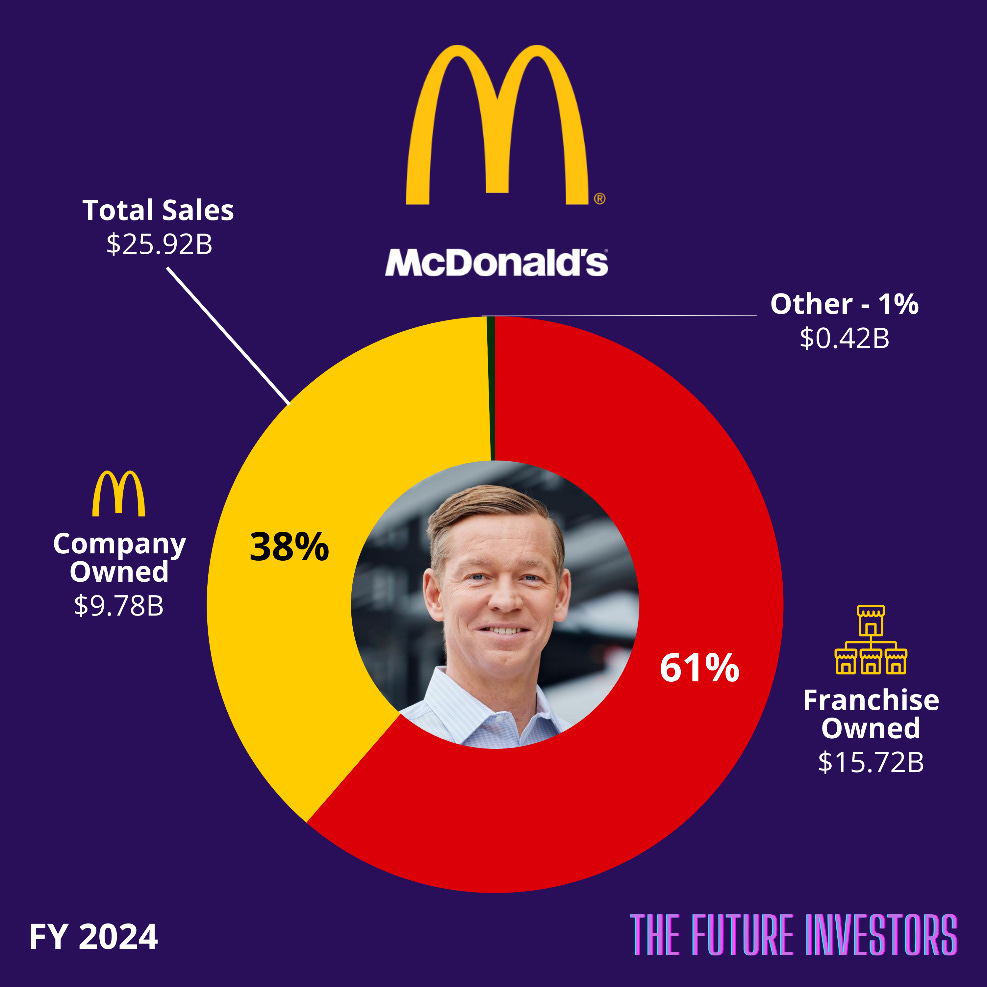
In 2024, McDonald's generated a total revenue of $25.92 billion. This revenue can be broken down into three key categories:
Franchise Owned (61%): This portion represents the revenue McDonald's earns from franchised restaurants. Franchisees operate the restaurants and pay a percentage of their sales to McDonald's as part of the franchise agreement.
Company Owned (38%): This is the revenue generated from McDonald's own restaurants, which are directly operated and managed by the company itself.
Other (1%): This category includes additional revenue from various business operations not directly related to restaurant sales.
Recent Developments
Over the years, McDonald's has continuously shown that it can adapt to changing customers' needs. Below are the most significant recent developments:
The $5 Meal Deal
McDonald’s introduced the $5 Meal Deal last year as a strategy to attract price-sensitive customers. This move responds to growing competition in the fast-food market and rising inflation, offering cheap options for customers looking for good meal deals.CosMc’s: A New Beverage Venture
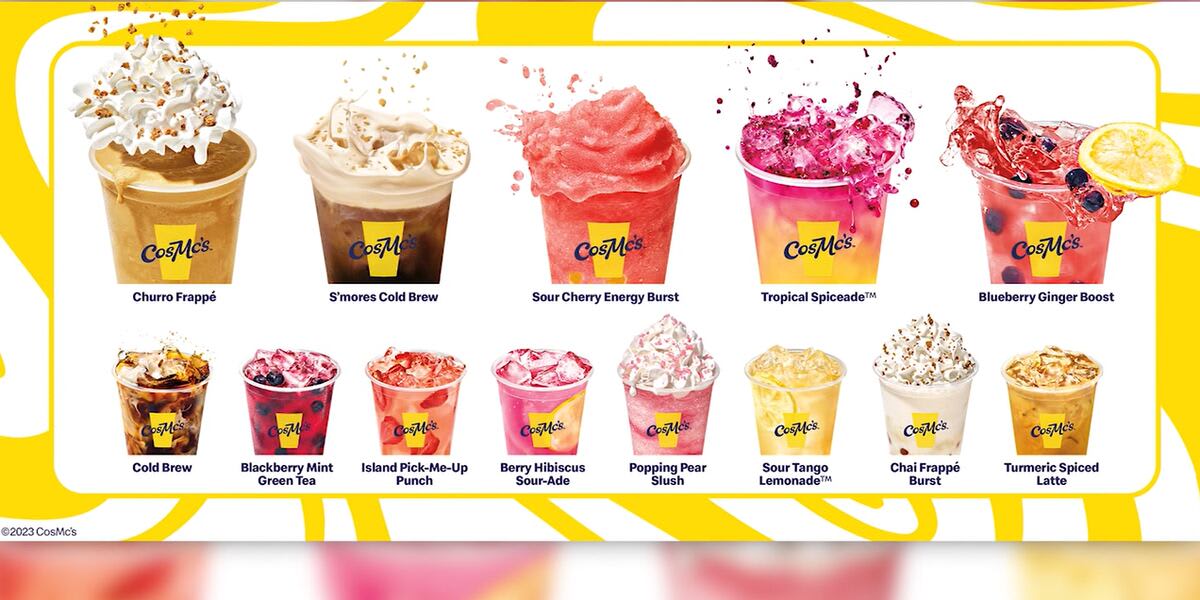
McDonald’s has launched CosMc’s, a new space-themed concept targeting the growing beverage market. With 75% of Starbucks' revenue coming from cold drinks, McDonald’s sees a major opportunity to compete by offering premium options like iced coffees, lemonades and other specialty drinks. The first location opened on December 7, 2023, in Bolingbrook, Illinois. McDonald's is also testing the concept in several locations across Texas. Fun fact: the name CosMc's is inspired by a alien character from McDonald’s commercials in the late 1980s.
Source: CosMc’s / BuzzFeed
Digitalization and AI in Drive-Thrus
McDonald’s is using AI in its drive-thrus to make ordering faster and easier. For example, McDonald's has introduced AI-powered voice-recognition at some locations that can understand customers and take orders automatically. This system can have conversations with customers, accurately record their orders, and, in some cases, even make recommendations based on previous orders or popular menu items. These updates are meant to make the customer experience smoother and more convenient.New Menu Options and Healthier Choices: McDonald's has changed its menu to include healthier options and plant-based alternatives, like the McPlant burger. This meets the growing demand for healthier and more sustainable food choices.
Expansion into Emerging Markets
McDonald’s has set ambitious growth targets, targeting 50,000 restaurants worldwide by 2027. A big part of this growth will happen in countries/regions like India, Southeast Asia, and Africa, where there is a lot of potential for new customers. By opening more restaurants in these regions, McDonald’s hopes to bring its food to more people and grow its global presence.
These efforts show that McDonald’s is focused on staying up-to-date, adjusting to new trends, and expanding into new markets to remain the leader in the fast-food industry.
Fundamental Analysis
In the fundamental analysis, we evaluate three key areas: management, market, and financials & growth estimates. Each area contains multiple elements and each element is scored individually, leading to a final score between 0 and 100.
Final Scoring
This score reflects how fundamentally attractive we believe the company is as an investment, ranging from:
🔴 Below 50 → Uninvestable
🟠 50 - 59 → Questionable
🟡 60 - 69 → Reasonable
🟢 70 - 79 → Quality
🔵 80 - 89 → High-Quality
🟣 90 or above → Exceptional
Unlock our scoring framework and full fundamental analysis below, and see how we score McDonalds on a scale from 0 to 100 — exclusively available to our paid members! 🚀
