


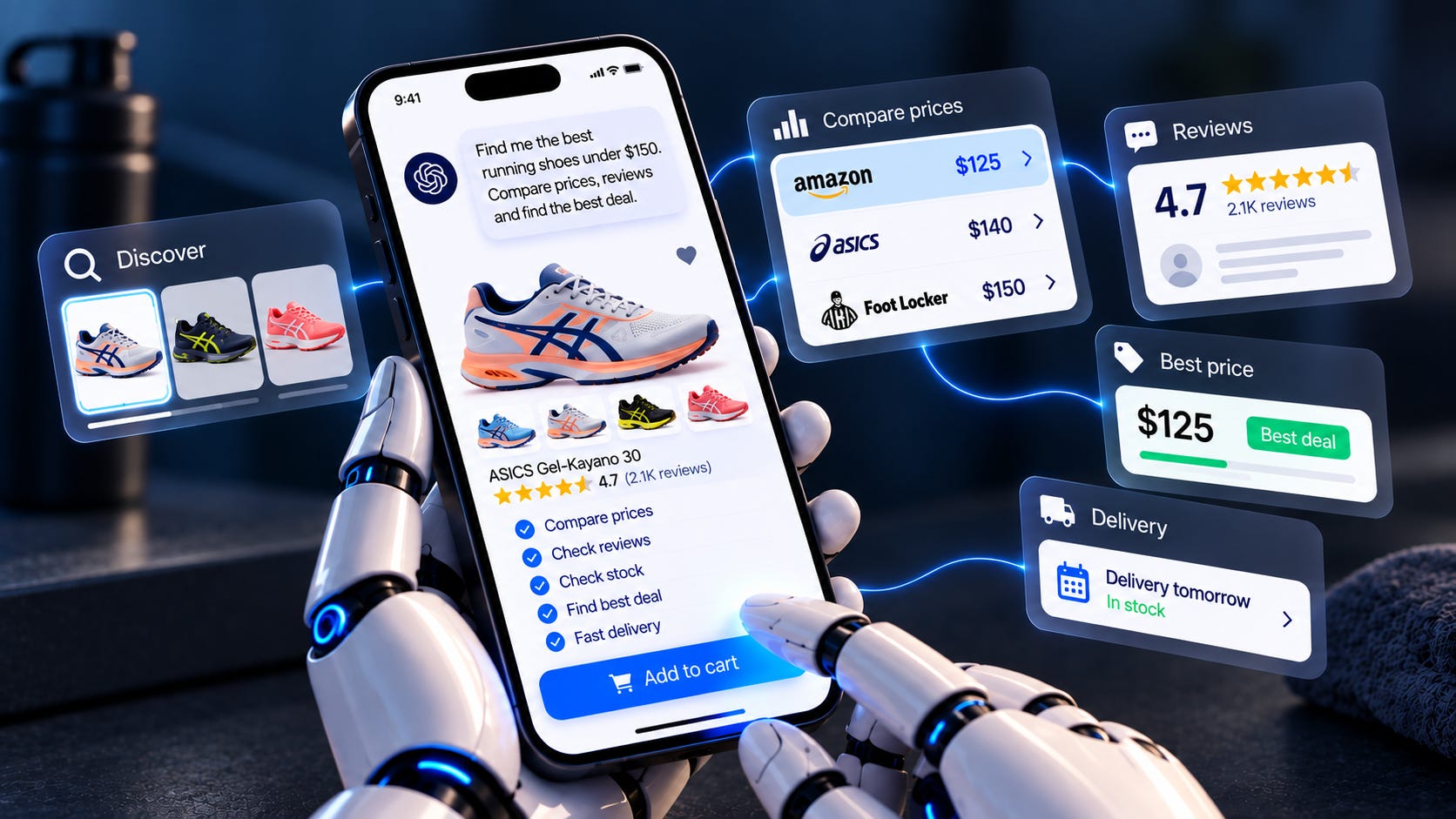
AI is changing the world in more and more ways, transforming how we work, search for information, create content and communicate. Now, AI is also starting to change how we discover products, shop online and ultimately pay.
Today, we still search for products, compare different websites and complete the checkout ourselves. But AI agents are starting to take over more of these steps. They can help discover products, compare options and even complete parts of the purchase for us. This is called agentic commerce.
And this shift is starting to accelerate, as AI platforms, retailers and payment companies race to shape the future of AI-powered shopping.
So what happens when AI starts doing more of the shopping for us?
In this article, we’ll look at:
🤖 What agentic commerce is and how it works
🛒 How agentic commerce will change the shopping journey
📈 How big the opportunity could become
♟️ The key players and where they fit in the ecosystem
🏆 Which companies we think are best positioned
🤖 What Is Agentic Commerce?
Agentic commerce is the next step in online shopping, where AI agents can do more than just recommend products or answer questions.
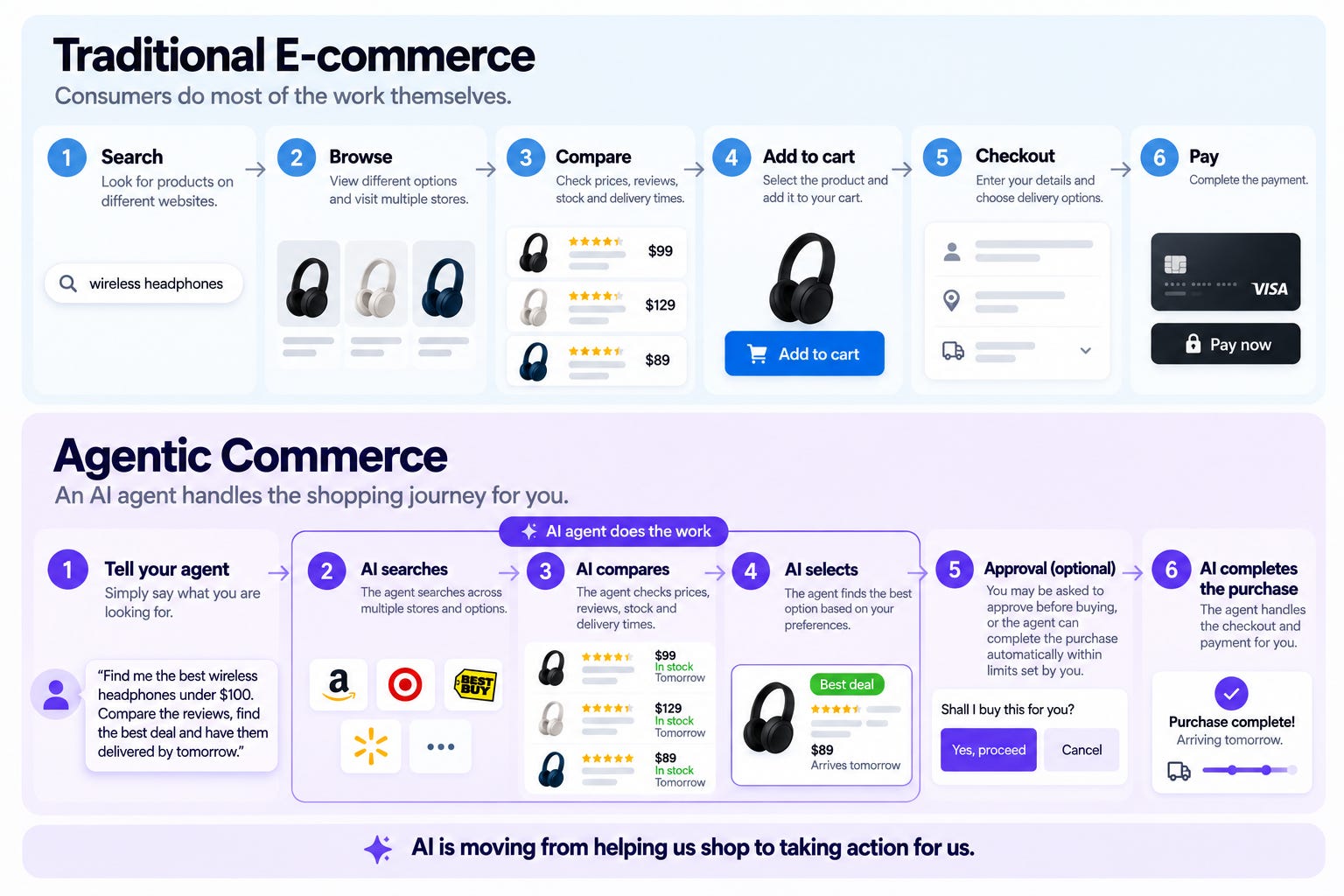
Today, consumers still do most of the work themselves. We search for products, visit different websites, compare options, add items to the cart, complete the checkout and make the payment. With agentic commerce, the shopping journey starts to look very different.
Instead of doing everything ourselves, we can simply tell an AI agent what we are looking for. The agent can search for products, compare prices, check reviews, look at stock and delivery times, and help complete the purchase for us.
For example:
“Find me the best wireless headphones under $100. Compare the reviews, find the best deal and have them delivered by tomorrow.”
The agent may still ask for approval before buying, or complete the purchase automatically within limits set by the user.
The visual below shows how traditional e-commerce compares with agentic commerce.
Source: The Future Investors Research. Visual created with AI.
The biggest difference is that AI is moving from helping us shop to taking action for us. That could make AI agents a new layer between consumers and online stores, affecting which products we see, where we buy them and how we pay.
🛒 How Shopping Will Change
Agentic commerce will change where shopping starts, how products are found and who owns the customer relationship.
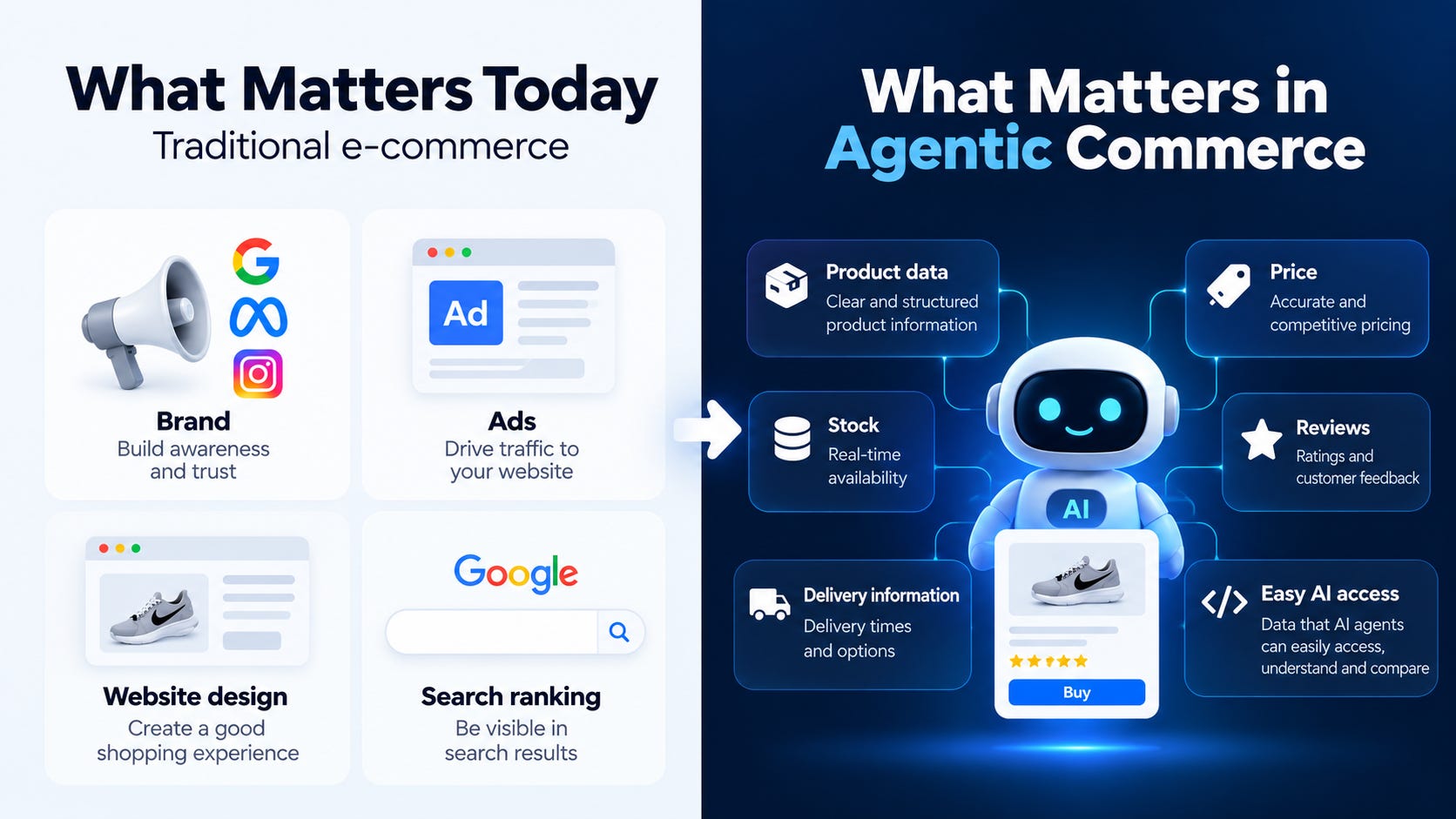
Today, many purchases still begin on Google, Amazon, social media or a retailer’s own website. As AI agents become part of shopping, more of that journey will start inside the AI assistant. That will also change what matters for retailers. A good-looking website will still matter, but AI agents will rely more on clear product data, price, stock, reviews and delivery information. Retailers will need to make this information easy for AI agents to access, understand and compare.
Source: The Future Investors Research. Visual created with AI.
The first signs are already here. Meta’s Muse can perform shopping tasks for users, and Shopify is opening its merchant network to AI platforms and shopping assistants. Shopify is already seeing the effect: in Q1 2026, AI-driven traffic to Shopify stores grew 8× year over year, and orders from AI-powered searches increased almost 13×.
Checkout will change too. More of the purchase can happen inside the AI experience itself, and payment companies are already building tools that connect AI agents with carts, checkout systems and payments. This could also change digital advertising. If AI agents choose which products to show, brands may need to compete for visibility inside AI systems, not just on search engines and social media.
Trust will become more important as well. Consumers need to know when an AI agent can buy automatically and when it needs approval.
That leads to a key question:
“Who owns the customer when the shopping journey starts with an AI agent?”
Some companies will make their products and services available to as many AI agents as possible. Others will try to keep shoppers inside their own platform. Agentic commerce will shift more power toward the companies that control discovery, product access, checkout and payments.
📈 The Opportunity
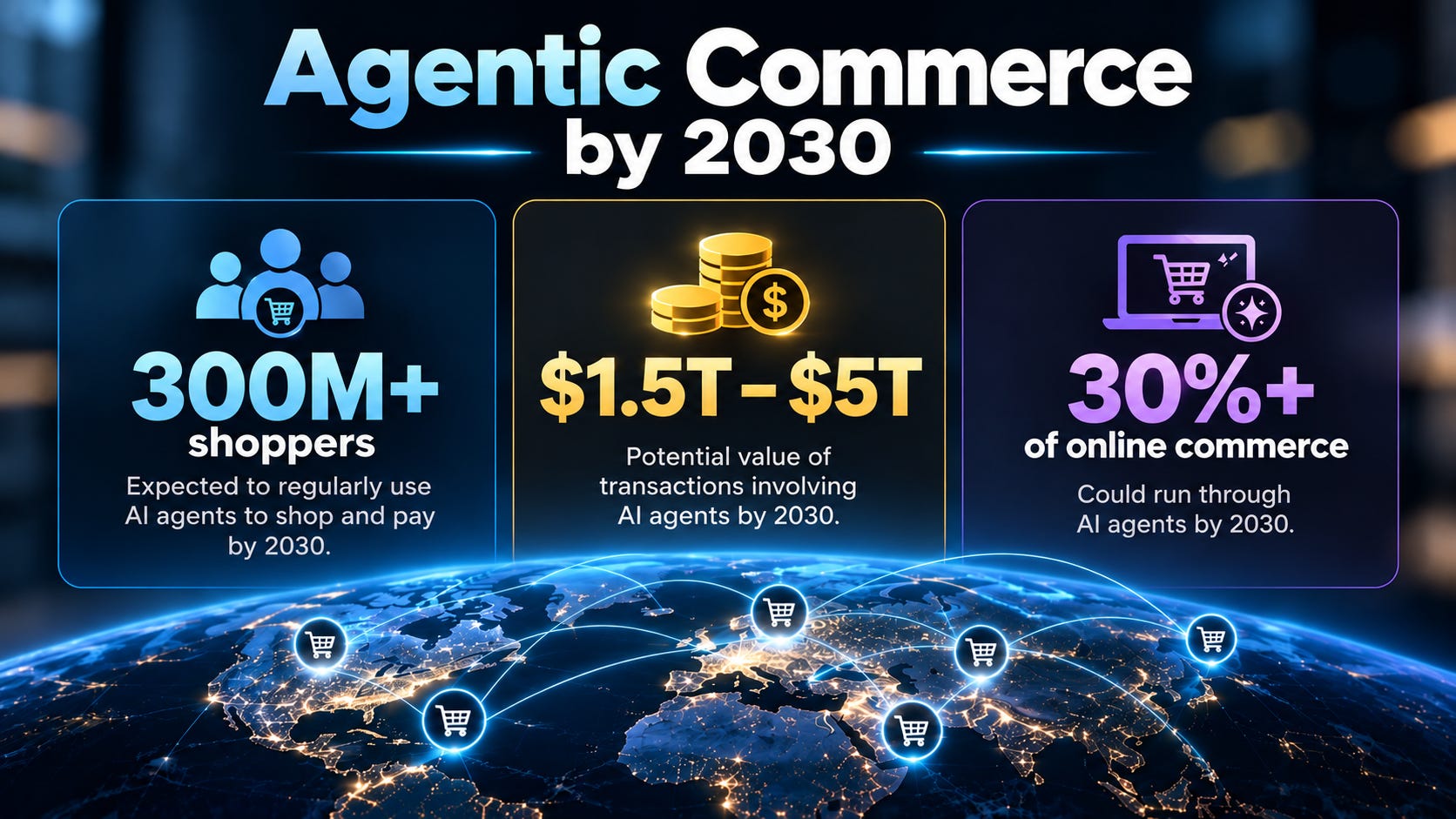
Agentic commerce is still at an early stage, but the numbers show how quickly it could grow. Mastercard expects more than 300 million online shoppers to regularly use AI agents to shop and pay by 2030, more than 1 in 10 online shoppers worldwide.
Other forecasts show how large the financial opportunity could become. By 2030, AI agents could be involved in $1.5 trillion to $5 trillion worth of transactions globally. Accenture also estimates that more than 30% of online commerce could run through AI agents by 2030, representing around $3.1 trillion in transactions.
Sources: Mastercard, Accenture and industry forecasts. Visual created with AI.
The estimates are not all the same, but they show one thing clearly: agentic commerce could become a major new channel for global commerce.
Adoption will not happen overnight. Trust, security and clear rules around identity, consent and authorization will be important before consumers are comfortable letting AI agents spend money on their behalf. Mastercard also says trust will play a big role in how quickly agentic commerce becomes widely used.
The opportunity is not only about more online sales. It also creates new opportunities across AI platforms, e-commerce software, checkout, payments and payment networks, which is why so many companies are now racing to build a position.
♟️ The Key Players
Agentic commerce is changing every part of the shopping journey, from the AI assistant and product discovery to checkout, payments and trust. Below are the key players in each part of the market.
🤖 AI Agents & Consumer Interfaces
These are the platforms where consumers can start the shopping journey with AI.
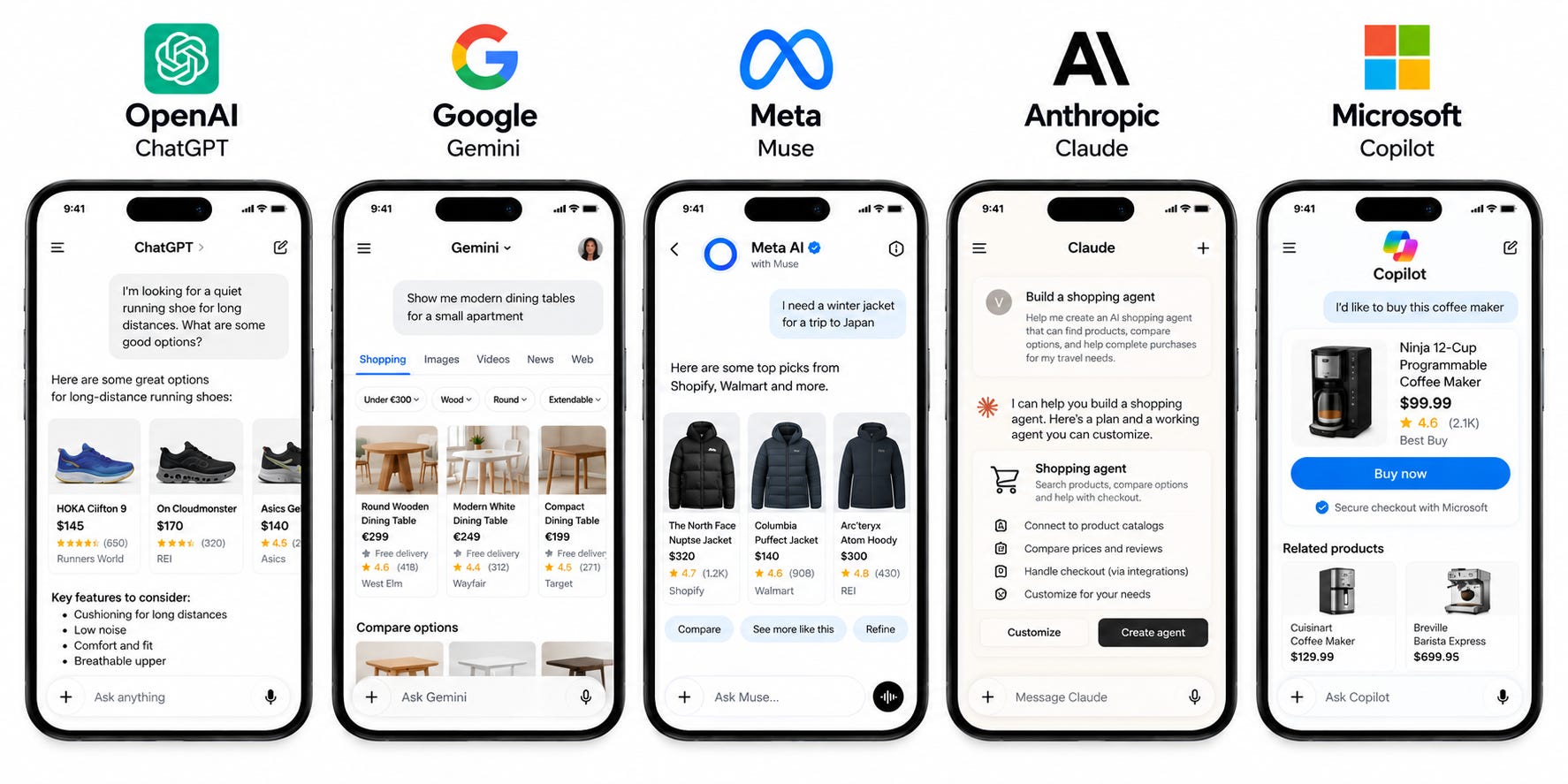
Source: Company websites. Interfaces are illustrative.
1️⃣ OpenAI (ChatGPT)
ChatGPT lets users discover, compare and buy supported products directly inside the chat. OpenAI’s Agentic Commerce Protocol (ACP), developed with Stripe, connects merchants with ChatGPT across product discovery and checkout. In March 2026, OpenAI expanded shopping with visual browsing and side-by-side product comparisons.
2️⃣ Alphabet (Gemini)
Google combines Gemini, Search, Shopping, Google Pay and the Universal Commerce Protocol (UCP). UCP was developed with Shopify, Etsy, Wayfair, Target and Walmart and is supported by more than 20 major companies. UCP-powered checkout is now rolling out in AI Mode and Gemini, starting with Etsy and Wayfair, with Shopify, Target and Walmart coming next.
3️⃣ Meta (Muse)
Muse is becoming a full shopping agent. It started with access to the Shopify catalog, and Meta has now added Walmart, Best Buy, Sephora, Wayfair and other major retailers. Shop Pay and PayPal are being added for payments, Expedia for travel and Instacart for grocery. Plaid connects financial accounts, and Muse can also use Stripe’s Link at more than 1 million businesses. Meta is bringing Muse to AI glasses and has introduced Muse Charm, a pocket-sized device for talking directly with Muse.
4️⃣ Anthropic (Claude)
Anthropic is focused on helping companies build their own shopping agents. In September 2026, it released Claude Commerce Agents for consumers and merchants across retail, travel, telecom and entertainment. The tools help shoppers browse and buy products, and help retailers manage inventory, pricing and promotions. Salesforce is bringing Claude Commerce Agents into Commerce Cloud, and Mastercard is making Anthropic’s commerce agent tools available through its Agent Suite for Merchants.
5️⃣ Microsoft (Copilot)
Microsoft is building both a shopping experience in Copilot and commerce tools for businesses. Copilot Checkout lets shoppers buy directly inside Copilot. On the business side, Dynamics 365 Commerce uses MCP (Model Context Protocol) to securely connect AI agents with live data such as products, pricing, inventory, carts, orders and fulfillment. This lets retailers use their existing commerce systems for AI shopping without rebuilding everything from scratch. Microsoft’s Commerce MCP Server is currently in preview.
🛍️ Commerce Platforms
These companies connect large numbers of products, merchants and customers.
1️⃣ Shopify
Shopify is becoming the central merchant layer for AI shopping. Its Agentic Storefronts connect merchants with ChatGPT, Google AI Mode, Gemini, Microsoft Copilot, and Meta Muse. The Shopify Catalog keeps product data structured and up to date. On supported AI channels, shoppers can complete purchases through Shopify-powered checkout. Shopify also co-developed the Universal Commerce Protocol (UCP) with Google.
See how Shopify brings products into AI conversations 🎥👇
2️⃣ Amazon
Amazon already controls product search, reviews, Prime, logistics, and checkout. Now, it is building its own agentic tools. Alexa for Shopping can compare products, track price history, build carts, and automate purchases. Its new ‘Buy for Me’ agent can even purchase products from external brand websites. Amazon is also protecting its own ecosystem. It recently blocked Meta’s Muse agent from shopping on Amazon.com to keep control over its marketplace data.
3️⃣ Salesforce
Salesforce powers the commerce infrastructure retailers use to build and run AI-powered shopping experiences. Its Shopper Agent, Buyer Agent and Merchant Agent automate shopping and retail tasks. Commerce Cloud connects with ChatGPT, Google Search and AI Mode, and is expanding into Gemini and Claude-based commerce agents. This helps retailers make their products and shopping experiences available across different AI platforms.
💳 Checkout Infrastructure
These companies connect AI agents with merchants and help complete the purchase.
1️⃣ Stripe
Stripe powers the checkout and payments behind AI shopping. It connects AI agents with merchants, processes payments and helps prevent fraud. Stripe co-developed OpenAI’s ACP, and its Link wallet lets Muse pay at more than 1 million businesses. For other approved purchases, Link can create a single-use virtual card.
2️⃣ Adyen
Adyen connects large merchants with different AI shopping platforms. Its Agentic Feed, Agentic Cart and Agentic Payments link product data, shopping carts and payments with AI agents. Merchants can connect once and then work with different AI platforms without rebuilding their systems each time.
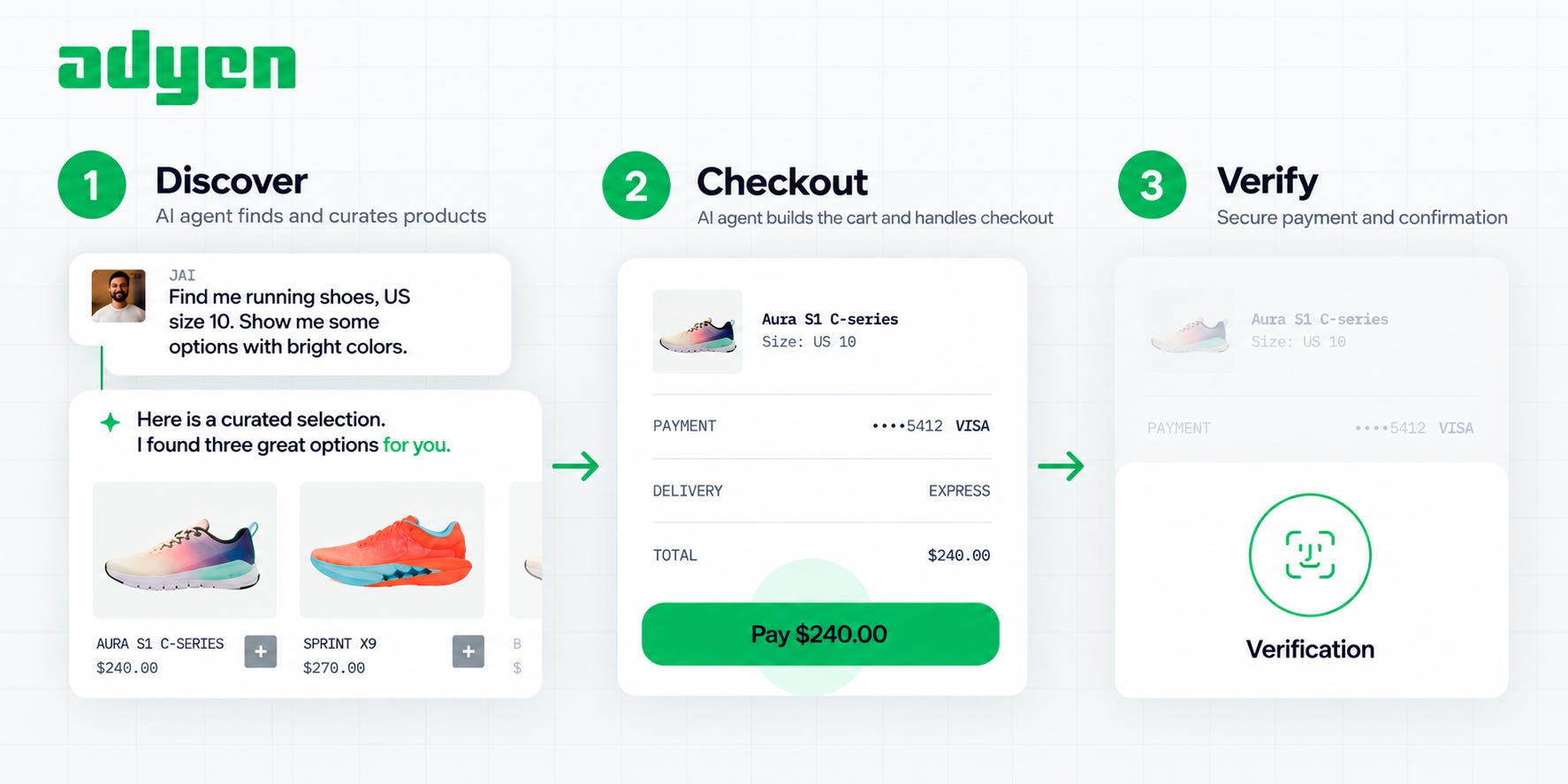
Source: Adyen. Visual based on Adyen Agentic product materials.
3️⃣ PayPal
PayPal connects products, carts and checkout with AI shopping assistants. Store Sync lets agents find products, build carts and complete purchases. WebMCP also helps AI agents use existing merchant websites and move shoppers into trusted PayPal checkout.
🛡️ Payments & Trust
These companies help make sure AI agents can be identified and trusted, and can safely make payments on a user’s behalf.
1️⃣ Visa
Visa is building the trust and payment layer for AI agents through Visa Intelligent Commerce. Its Trusted Agent Protocol helps merchants verify trusted AI agents, supported by Agent Scoring and an Agentic Registry. Visa is also working with OpenAI on agentic commerce. Together with Mastercard and Ant International, it is developing a cross-network Know Your Agent (KYA) framework.
See Visa Intelligent Commerce in action 🎥👇
2️⃣ Mastercard
Mastercard is building its trust layer through Agent Pay. Its Verifiable Intent technology checks that an AI agent follows the user’s instructions and spending limits. Mastercard also launched Agent Connect, linking merchants, AI agents and payment providers, and is working with Visa and Ant International on a new cross-network Know Your Agent (KYA) framework.
3️⃣ Cloudflare
Cloudflare is building the identity and wallet layer for AI agents. Cloudflare Wallets give agents their own identity and programmable wallet, with limits on spending and where they can shop. Cloudflare also supports x402, which lets AI agents automatically pay for digital services, often using stablecoins.
Stablecoins could also become important for AI agents, enabling instant, cross-border and machine-to-machine payments. Coinbase is helping build this through x402, a system that lets AI agents pay automatically for digital services. Circle is building its Agent Stack around USDC, giving AI agents wallets and tools to make payments on their own.
We’ve now seen how agentic commerce works, how it will reshape the shopping journey, how large the opportunity could become and who the key players are in each part of the market ♟️
In the next part, we’ll reveal which companies we believe are best positioned to dominate the agentic commerce era 🏆
This content is exclusively available to our paid subscribers ✨
🔥 Upgrade Now and Save 30%!
Get instant access to this insight article, our Portfolios & Transactions, our monthly Best Buys, all 15+ Deep Dives, all 95+ Stock Battles — plus 425+ premium articles to explore!
✅ Trusted by 4,800+ investors.
🏆 Who Is Best Positioned?
We’ve seen that agentic commerce is a big opportunity and will change how people discover, shop and pay. We’ve also identified the key players. But which companies look most interesting from an investor perspective?
In this chapter, we’ll reveal which companies we believe are best positioned to dominate the agentic commerce era.
We focus only on publicly traded companies, so OpenAI, Anthropic and Stripe are excluded for now. We’ll choose one company from each of the four areas: AI agents & consumer interfaces, commerce platforms, checkout infrastructure, and payments & trust.
Let’s start with our #1 pick in AI Agents & Consumer Interfaces 🤖👇