

Welcome to the 8th edition of Unpacked, our monthly series where we take a deep dive into a company. This time, we’re taking a closer look at SoFi Technologies — a fast-growing U.S. fintech platform transforming consumer finance across banking, lending, and investing.
We break down its story, business model, and highlight the latest developments.
Additionally, we do a detailed fundamental analysis, diving into the company’s management, market, financials, and growth estimates. We score each area separately, leading to a final score between 0 and 100. This score reflects how fundamentally attractive we believe the company is as an investment, ranging from:
🔴 Below 50 → Uninvestable
🟠 50 - 59 → Questionable
🟡 60 - 69 → Reasonable
🟢 70 - 79 → Quality
🔵 80 - 89 → High-Quality
🟣 90 or above → Exceptional
The goal? To give you a full deep dive into this company, as a complement to your own research, so you can decide if it’s the right investment for you.
In case you missed it, here you can read the previous editions of Unpacked:
Now let’s unpack the fundamentals of SoFi Technologies — and see how we score it!
History and Business Model
SoFi Technologies was founded in 2011 at Stanford University by Mike Cagney, Dan Macklin, James Finnigan and Ian Brady. The idea was simple: help students refinance their expensive loans with better technology and a smoother experience. It worked and SoFi grew quickly.
By 2015, the company moved beyond student loans into mortgages and personal loans, positioning itself as a modern, mobile-first alternative to traditional banks.
A key moment came in 2018, when Anthony Noto became CEO. Under his leadership, SoFi turned into a much broader platform. Instead of focusing on just one product, SoFi wanted to help people manage all their money in one place: saving, spending, borrowing, investing and budgeting.
That idea turned into the mission that still guides SoFi today:
”Help people reach financial independence to realize their ambitions.”
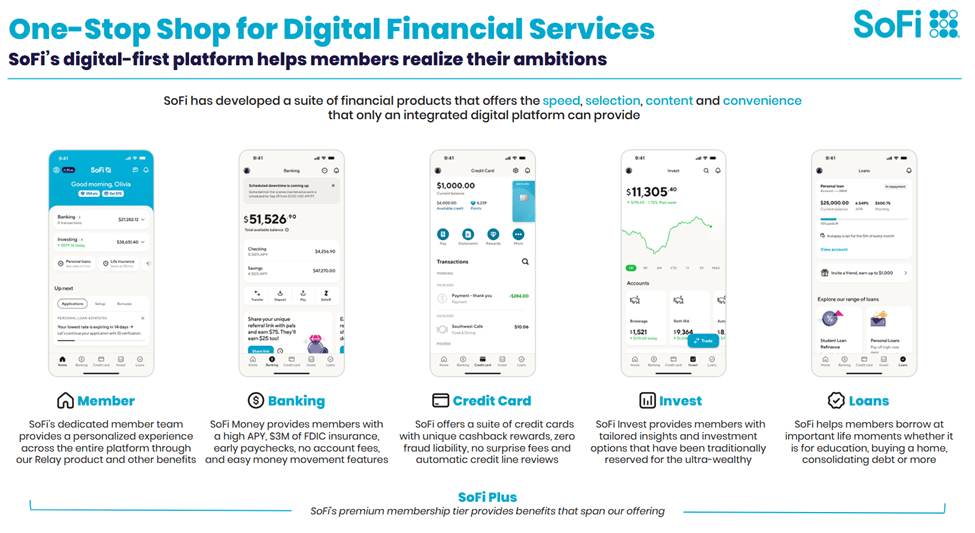
Source: SoFi One-Stop Shop, Investor Presentation
In 2021, SoFi went public on the Nasdaq, giving the company more resources to grow. A year later, in 2022, it received its U.S. bank charter — allowing SoFi to offer checking and savings accounts and fund its own loans at lower cost. This marked its shift from fintech startup to fully licensed digital bank.
From 2023 to 2025, SoFi expanded further with its banking products and its tech platforms, Galileo and Technisys, which now power many other fintech companies. Today, SoFi is building toward its long-term vision: becoming the financial operating system of the future.
Business Model explained
SoFi runs a fully digital financial platform built on three key areas:
💸 1. Lending
Lending is the core of SoFi’s business. It includes student loans, personal loans and home loans, which together generate most of SoFi’s revenue. The company earns money from interest on loans, from selling some loans into the secondary market, and from members who take additional SoFi products.
Because SoFi has a bank charter, it can fund loans with low-cost deposits, giving it stronger margins than most fintechs.
🏦 2. Financial Services
Financial Services covers everything that helps members manage and grow their money in one place. This includes checking & savings, SoFi Invest (stocks, ETFs, crypto), the SoFi credit card, insurance partnerships, and SoFi’s budgeting tools.
These products increase daily engagement and often lead members to use more SoFi services over time — a key part of its ecosystem strategy.
🧩 3. Tech Platform
SoFi also provides technology to other fintechs and digital banks. Galileo handles payments and card issuing, while Technisys provides cloud-based core banking systems.
This brings in steady, recurring revenue and adds a technology layer that makes SoFi different from most digital-only banks.
In the video below, CEO Anthony Noto explains how SoFi grew into a full financial platform 🎥👇
Revenue Breakdown
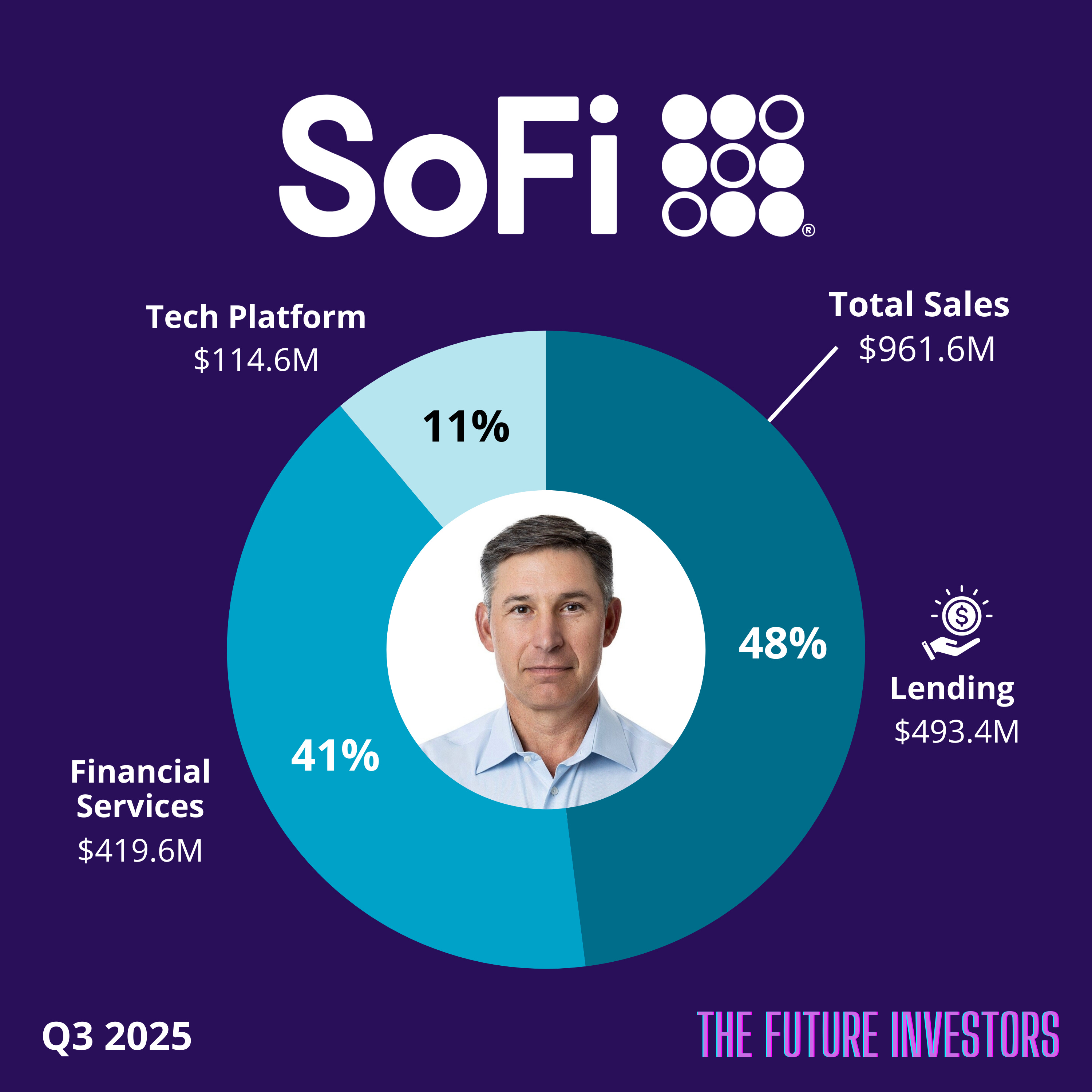
On October 28, 2025, SoFi reported its Q3 2025 results. Net revenue reached $961.6 million, up +39% from Q3 2024.
💸 Lending – $493.4 million (48%)
Lending remains SoFi’s largest revenue source. Strong demand for personal loans and low-cost deposit funding helped drive solid margins in the quarter.
🏦 Financial Services – $419.6 million (41%)
Financial Services is catching up quickly to Lending. Growth in checking & savings balances, card spend, and investing activity pushed this segment close to record revenue.
🧩 Technology Platform – $114.6 million (11%)
Galileo and Technisys delivered steady growth as payment volumes increased and new fintech clients joined the platform.
Recent Developments
Over the past year, SoFi has continued its evolution from a fast-growing fintech into a fully integrated digital financial platform. Here are the most important developments from late 2024 to today:
1️⃣ Major Loan Platform Expansion
In April 2025, SoFi secured $3.2 billion in new funding for its Loan Platform Business through agreements with Fortress and Edge Focus. This helps SoFi grow its personal loan offering while using less of its own balance sheet.
2️⃣ New Investment Products & IPO Access
SoFi expanded into private-market investing, giving members access to companies like OpenAI and SpaceX with low minimums. It also launched a new IPO access tool with PrimaryBid, allowing members to join public offerings earlier than before.
3️⃣ Crypto Launch Inside SoFi Bank
In November 2025, SoFi became the first nationally chartered U.S. bank to offer crypto trading directly inside a bank account — a major step in blending traditional banking with digital assets.
4️⃣ Blockchain-Based Money Transfers
Mid-2025, SoFi introduced a new international money transfer service using Lightspark’s blockchain technology. It moves money faster and cheaper by converting USD → BTC → local currency, starting with Mexico.
5️⃣ Product Innovation Across the App
SoFi released several new features to boost engagement: Level 1 options trading, smarter AI tools inside Cash Coach, new budgeting features, updates to SoFi Invest, and better credit card rewards.
6️⃣ Launch of the Agentic AI ETF
In September 2025, SoFi introduced AGIQ, an ETF focused on the next wave of AI companies — adding another accessible investment option for its members.
7️⃣ New Office Expansion
In October 2025, SoFi opened a new hub in Ballantyne (Charlotte, NC) to grow its engineering, operations, and financial services teams outside Silicon Valley.
8️⃣ Record Member Growth
SoFi passed 12.6 million members in Q3 2025 after adding a record 905,000 members in one quarter — up 35% year over year. The company now expects to add at least 3.5 million new members in 2025, showing strong demand and rising engagement across its platform.
🔥 Black Friday Deal: 40% Off 🎁
Unlock instant access to the full SoFi deep dive, all past deep dives, our complete portfolios, the monthly Best Buys — plus 350+ premium articles ✨
Upgrade today for just $288/year
That’s only $0.77 per day — and you save $738 💸
Full access, cancel anytime ✅
⏳ Black Friday Deal ends this Monday. Don’t miss it.
Fundamental Analysis
Now it’s time for the fundamental analysis of SoFi.
In this section, we evaluate three key areas: management, market, and financials & growth estimates. Each area contains multiple elements and each element is scored individually, leading to a final score between 0 and 100.
Final Scoring
This score reflects how fundamentally attractive we believe SoFi is as an investment, ranging from:
🔴 Below 50 → Uninvestable
🟠 50 - 59 → Questionable
🟡 60 - 69 → Reasonable
🟢 70 - 79 → Quality
🔵 80 - 89 → High-Quality
🟣 90 or above → Exceptional
Unlock our scoring framework and full fundamental analysis below, and see how we score SoFi on a scale from 0 to 100 — exclusively available to our paid members! ✨