


Welcome to the 10th edition of Unpacked, our monthly series where we take a deep dive into a company. This time, we’re taking a closer look at Salesforce — a global cloud software leader and the world’s #1 CRM platform, helping businesses manage sales, service, marketing, data, and AI in one ecosystem.
We break down its story, business model, and highlight the latest developments.
Additionally, we do a detailed fundamental analysis, diving into the company’s management, market, financials, and growth estimates. We score each area separately, leading to a final score between 0 and 100. This score reflects how fundamentally attractive we believe the company is as an investment, ranging from:
🔴 Below 50 → Uninvestable
🟠 50 - 59 → Questionable
🟡 60 - 69 → Reasonable
🟢 70 - 79 → Quality
🔵 80 - 89 → High-Quality
🟣 90 or above → Exceptional
The goal? To give you a full deep dive into this company, as a complement to your own research, so you can decide if it’s the right investment for you.
In case you missed it, here you can read the previous editions of Unpacked:
Now let’s unpack the fundamentals of Salesforce and see how we score it!
History and Business Model
Salesforce was founded in 1999 by Marc Benioff and a small team in San Francisco. At the time, most business software had to be installed on company servers. It was expensive, complex, and slow to update. Salesforce changed that.
From day one, it focused on delivering software through the cloud. Customers could simply log in through a browser and pay a subscription fee. No installation. No heavy IT setup. This “Software-as-a-Service” (SaaS) model was revolutionary at the time.
The company started with one product: Sales Cloud. Over time, it expanded into Service Cloud, Marketing Cloud, Commerce, Analytics, Integration, Collaboration, and now AI.
Salesforce also grew through major acquisitions, including:
MuleSoft (integration software)
Tableau (data visualization & analytics)
Slack (workplace collaboration)
Today, Salesforce is one of the largest enterprise software companies in the world, serving businesses of all sizes across nearly every industry.
Its mission is simple:
“To bring out the best in one another, deliver success to our customers and inspire the entire industry through our actions.”
The video below gives a clear overview of what Salesforce is and what it does 🎥👇
Business Model Explained
Salesforce is a cloud-based enterprise software company. It sells digital tools that help businesses manage customer relationships, data, and internal workflows through one integrated platform.
Its ecosystem is built around Customer 360, a unified system that connects sales, service, marketing, commerce, data, and AI in one place.
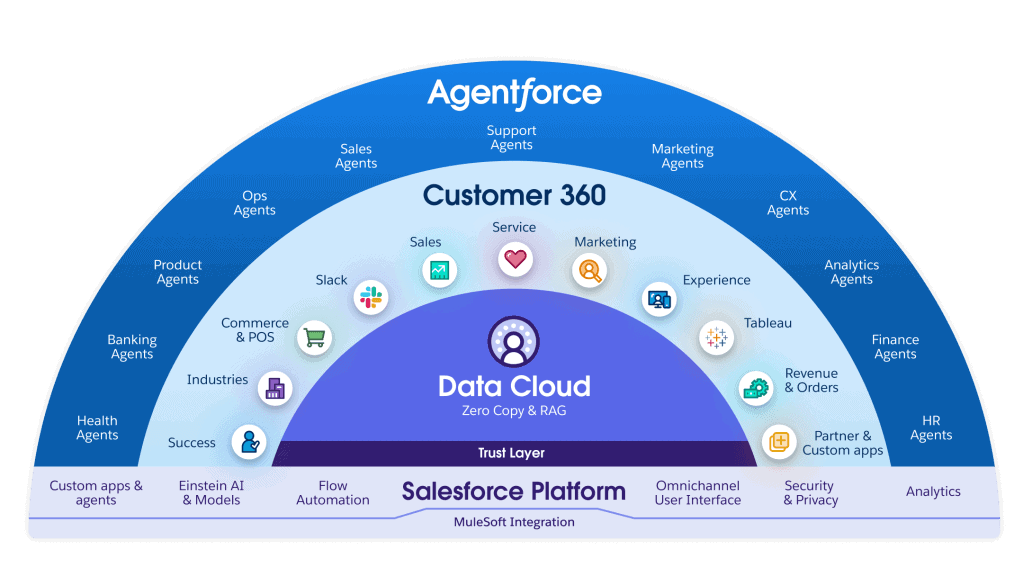
Source: Salesforce Investor Relations
The company operates mainly through subscriptions. Customers typically sign 1–3 year contracts and pay per user, per month. This creates predictable and recurring revenue.
Salesforce organizes its products into different “Clouds,” each focused on a business function. Here’s how the model works:
☁️ 1. Sales Cloud
Helps sales teams manage leads, track deals, and forecast revenue. This was Salesforce’s first product and remains one of its largest.
🎧 2. Service Cloud
Customer support software for help desks, call centers, and digital support channels.
📢 3. Marketing & Commerce Cloud
Tools for digital marketing, personalization, and online commerce experiences.
📊 4. Data Cloud & Analytics
Data Cloud unifies customer data from multiple sources into one real-time platform. This powers better insights, automation, and AI use cases. Analytics tools like Tableau help companies visualize and understand that data.
🔗 5. Integration & Platform
MuleSoft and the Salesforce Platform allow companies to connect different systems and build custom applications on top of Salesforce.
🤖 6. AI Layer (Einstein & Agentforce)
AI is built across the Salesforce platform. Einstein looks at data in Customer 360 and Data Cloud to provide predictions, insights, and suggestions — for example, which leads are most likely to close or the next step in a service case. Agentforce takes these insights and automates tasks, like handling sales activities, solving service requests, or helping employees — all using trusted company data.
⚖️ Why this model works
Salesforce benefits from:
High switching costs (once embedded, companies rarely leave)
Recurring subscription revenue
Upselling across multiple Clouds
A strong partner ecosystem
Large enterprise contracts
Once a company starts with one Cloud, it usually expands into others, creating long-term relationships and steady growth.
Over time, Salesforce becomes deeply embedded in daily operations, making it complex and risky to replace. That’s what makes the business model so durable.
Revenue Breakdown
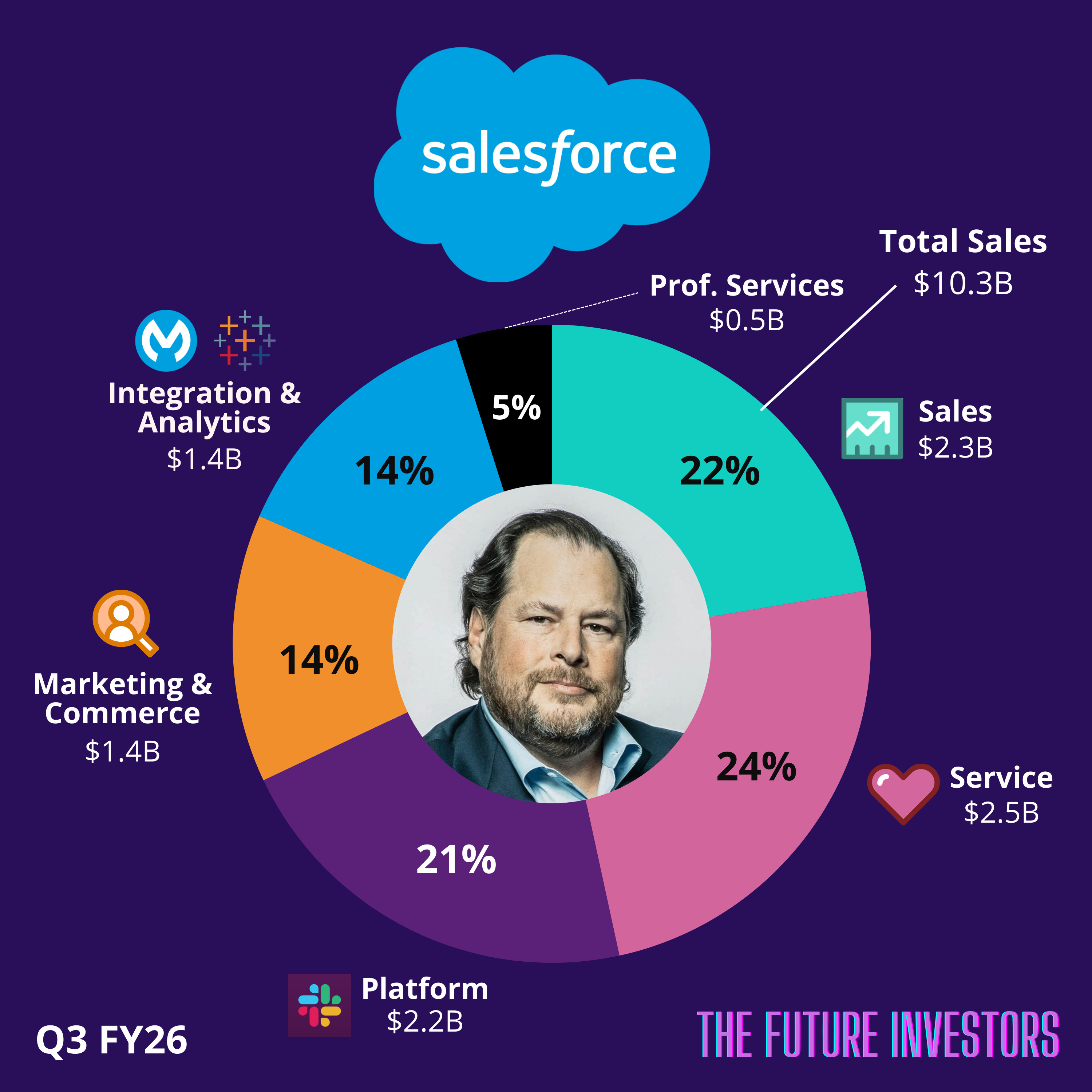
On December 3, 2025, Salesforce reported its Q3 FY26 results for the period ended October 31, 2025. Total revenue was $10.3 billion, up about 9% compared to last year.
🧠 Sales – $2.3B (22%)
Steady growth from Sales Cloud as more companies use Salesforce for managing leads and deals.
🎧 Service – $2.5B (24%)
Service Cloud is a core driver, with customers relying on it for support and help desk operations.
📊 Platform, Slack & Other – $2.2B (21%)
Above-average growth as customers adopt multiple Clouds and build custom apps and workflows.
📢 Marketing & Commerce – $1.4B (14%)
Strong growth here, driven by digital marketing and online commerce tools.
📈 Integration & Analytics – $1.4B (14%)
Rapid growth from Data Cloud and Tableau, which provide unified data and analytics that power AI and automation.
🖥️ Professional Services & Other – $0.5B (5%)
Implementation and consulting services are just a small part of total revenue.
Sales and Service are the largest segments, but Marketing, Platform, and Analytics are growing fastest, showing Salesforce’s push into AI, automation, and cross-cloud adoption.
Recent Developments
Salesforce has entered a new phase focused on AI acceleration, strategic acquisitions, and large enterprise deals. Here are the latest key developments:
1️⃣ AI Revenue Acceleration
In the Q3 FY26 earnings report, Salesforce reported that its Agentforce and Data 360 products reached nearly $1.4 billion in annual recurring revenue, growing 114% YoY. This shows that AI is becoming an increasingly important driver of revenue growth.
2️⃣ Strategic Acquisitions
Salesforce announced the acquisition of Informatica, a major step to improve how companies organize and manage their data. It also acquired smaller AI-focused companies such as:
Cimulate
Spindle AI
Momentum
These acquisitions help improve data organization, automation, and sales intelligence within the platform.
3️⃣ Partnerships & Model Integrations
Salesforce expanded partnerships with OpenAI, Anthropic, and Google.
Agentforce now connects with models like ChatGPT, Claude, and Gemini, allowing enterprises to securely link external AI models to Salesforce data.
4️⃣ Major Government Deal
Salesforce signed a $5.6 billion agreement with the United States Army, underlining its continued strength in large, long-term contracts.
5️⃣ FY30 Target: $60 Billion Revenue
At Investor Day, management reaffirmed its goal of reaching $60 billion in revenue by FY30. The company also expects to return to double-digit revenue growth in the coming years.
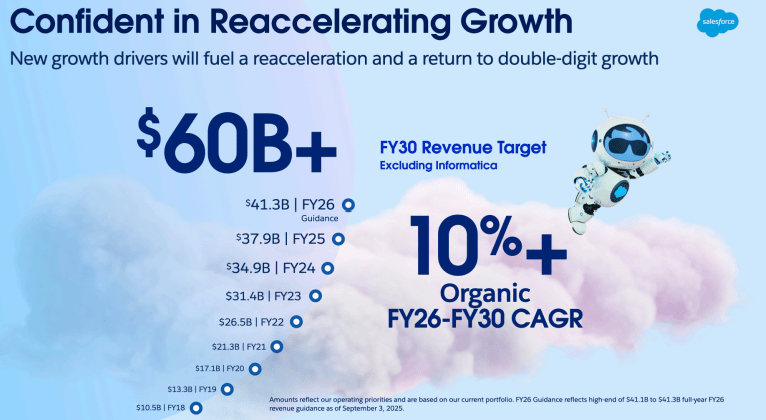
Source: Salesforce Investor Day Presentation
6️⃣ Stock Decline & AI Concerns
The stock has fallen about 50% from its all-time high. A major reason is growing uncertainty around AI.
Some investors believe powerful AI agents could take over many business tasks on their own. The fear is that if AI can manage workflows directly through APIs, companies may need fewer software licenses, or see parts of platforms like Salesforce as replaceable. For example, if one AI agent can handle the workload of five customer service employees, companies may need fewer paid user licenses. That could directly pressure Salesforce’s traditional per-seat pricing model. This is the core risk investors are debating today.
The key question is simple: will AI make traditional software less important, or will it increase the need for platforms that organize data and workflows?
Later in the fundamental analysis, we will take a deeper look at this topic.
🔥 Upgrade now to paid and get 30% off!
Get instant access to this Salesforce Deep Dive, all other Deep Dives, our Top 10 Picks for 2026, our Portfolios, our monthly Best Buys — plus 375+ premium articles to explore!
✅ Already trusted by 4,400+ investors.
Fundamental Analysis
Now it’s time for the fundamental analysis of Salesforce.
In this section, we evaluate three key areas: management, market, and financials & growth estimates. Each area contains multiple elements and each element is scored individually, leading to a final score between 0 and 100.
Final Scoring
This score reflects how fundamentally attractive we believe Salesforce
is as an investment, ranging from:
🔴 Below 50 → Uninvestable
🟠 50 - 59 → Questionable
🟡 60 - 69 → Reasonable
🟢 70 - 79 → Quality
🔵 80 - 89 → High-Quality
🟣 90 or above → Exceptional
Unlock our scoring framework and full fundamental analysis below, and see how we score Salesforce on a scale from 0 to 100 — exclusively available to our paid members! ✨