


Welcome to the 11th edition of Unpacked, our monthly series where we take a deep dive into a company. This time, we’re taking a closer look at Uber — the world’s leading mobility and delivery platform, connecting millions of riders, drivers, couriers, and merchants across thousands of cities globally.
We break down its story, business model, and highlight the latest developments.
Additionally, we do a detailed fundamental analysis, diving into the company’s management, market, financials, and growth estimates. We score each area separately, leading to a final score between 0 and 100. This score reflects how fundamentally attractive we believe the company is as an investment, ranging from:
🔴 Below 50 → Uninvestable
🟠 50 - 59 → Questionable
🟡 60 - 69 → Reasonable
🟢 70 - 79 → Quality
🔵 80 - 89 → High-Quality
🟣 90 or above → Exceptional
The goal? To give you a full deep dive into this company, as a complement to your own research, so you can decide if it’s the right investment for you.
In case you missed it, here you can read the previous editions of Unpacked:
Now let’s unpack the fundamentals of Uber and see how we score it!
History and Business Model
It all started in Paris. In December 2008, Travis Kalanick and Garrett Camp couldn’t find a taxi on a snowy night. That led to a simple question: what if you could request a ride by tapping a button?

Source: Caribbean Value Investor
In 2009, they launched UberCab in San Francisco as a premium ride service, later renamed Uber. The app connects riders with nearby drivers and includes navigation and payments in one platform.
The company later introduced lower-priced options like UberX and expanded into more cities worldwide. As smartphone use increased, Uber grew into a widely used transportation platform.
Over time, Uber expanded beyond ride-hailing. It launched Uber Eats in 2014 for food and grocery delivery and entered freight in 2017, connecting businesses with carriers.
Uber does not own vehicles or employ drivers directly. It offers a platform that connects users and earns a fee on each trip or delivery.
Today, Uber operates in thousands of cities globally and facilitates billions of trips and deliveries each year. This is reflected in its mission:
“We reimagine the way the world moves for the better.”

Source: Uber Reimagine Mobility Update
Business Model Explained
Uber is a global platform that connects riders, drivers, couriers, and businesses in one app.
Its business is built around three segments:
🚗 1. Mobility
Users request a ride in the app and can choose from options like UberX, Uber Comfort, or Uber Black. Drivers decide which trips to accept and complete the ride.
🍔 2. Delivery
Users order food, groceries, and other items with Uber Eats. Restaurants and stores prepare the orders, and couriers pick them up and deliver them.
🚛 3. Freight
Businesses use Uber to arrange transport for goods, while carriers use the platform to find loads.
How Uber makes money 💰
Each transaction works in the same way. A user makes a request, a driver or courier accepts it, and after the trip or delivery is completed, Uber takes a percentage of the total amount. This is called the take rate, so revenue increases as usage grows.
Uber also earns extra revenue from Uber One, a subscription with discounts and benefits, and from Uber Ads, where businesses pay for better visibility in the app.
Many users use more than one service in the same app, like rides and food delivery. More usage leads to more revenue, as rides, orders, and deliveries increase.
Mobility and Delivery are the core of Uber today, while Uber One and Uber Ads add extra revenue on top of the platform.
Revenue Breakdown
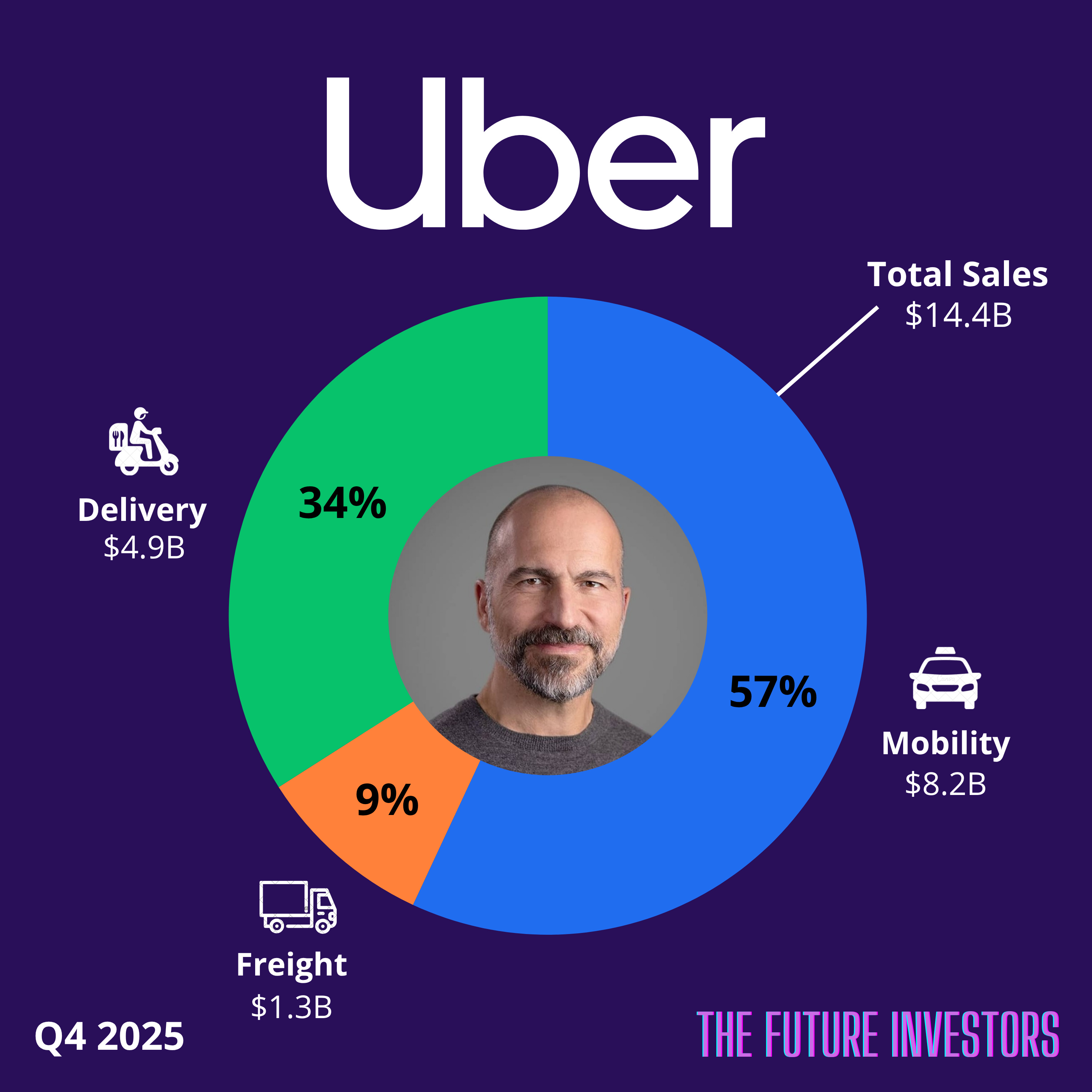
On February 4, 2026, Uber reported its Q4 2025 results for the period ended December 31, 2025. Total revenue was $14.4 billion, up 20% year-over-year.
🚗 Mobility – $8.2B (57%)
Uber’s largest segment. Revenue comes from ride-hailing services, where users pay for trips and Uber takes a percentage of each fare. Revenue grew 19% YoY, from $6.9 billion to $8.2 billion.
🍔 Delivery – $4.9B (34%)
Includes food, groceries, and other local commerce through Uber Eats. Customers place orders in the app, and Uber earns a fee on each order. Revenue increased 30% YoY, from $3.8 billion to $4.9 billion.
🚛 Freight – $1.3B (9%)
Focused on connecting shippers with carriers to move goods. Uber earns fees for matching and managing shipments. Revenue was $1.3 billion, the same as last year.
Mobility is still Uber’s largest segment, but Delivery is growing faster. Freight is relatively small and had limited impact on overall growth.
Recent Developments
Uber is expanding its platform across mobility, delivery, and logistics, while positioning itself at the center of the autonomous mobility ecosystem. Here are the key recent developments:
1️⃣ Autonomous Strategy & Partnerships
Uber is rapidly building a global network of autonomous partners instead of developing the technology itself. The company launched Uber Autonomous Solutions, a platform designed to help partners deploy and scale autonomous vehicles on Uber’s network, including tools for fleet operations, customer support, and in-vehicle experience.
Uber has signed 20+ partnerships globally across autonomous mobility and supporting infrastructure. Recent partnerships include:
Rivian → plans to deploy up to 50,000 robotaxis, starting in 2028
Motional → robotaxi rollout starting in 2026
Waymo → already live in cities like Austin and Atlanta through the Uber app
Lucid & Nuro → 20,000 premium robotaxis, with launches starting in 2026
Wayve & Nissan → robotaxi pilots in Japan around 2026
Zoox → robotaxi deployment expected from 2027
WeRide → up to 1,200 robotaxis in the Middle East
Baidu (Apollo Go) → expansion of robotaxi services in Dubai
Avride → robotaxi and delivery services already live in selected cities
Aurora → autonomous trucking integrated into Uber Freight
Uber is also investing $100 million in EV charging infrastructure to support autonomous fleets.
Robotaxi services are already live in multiple cities, with plans to expand to 15 cities by 2026. Uber’s strategy is clear: to become the largest platform for autonomous vehicle trips globally by 2029.
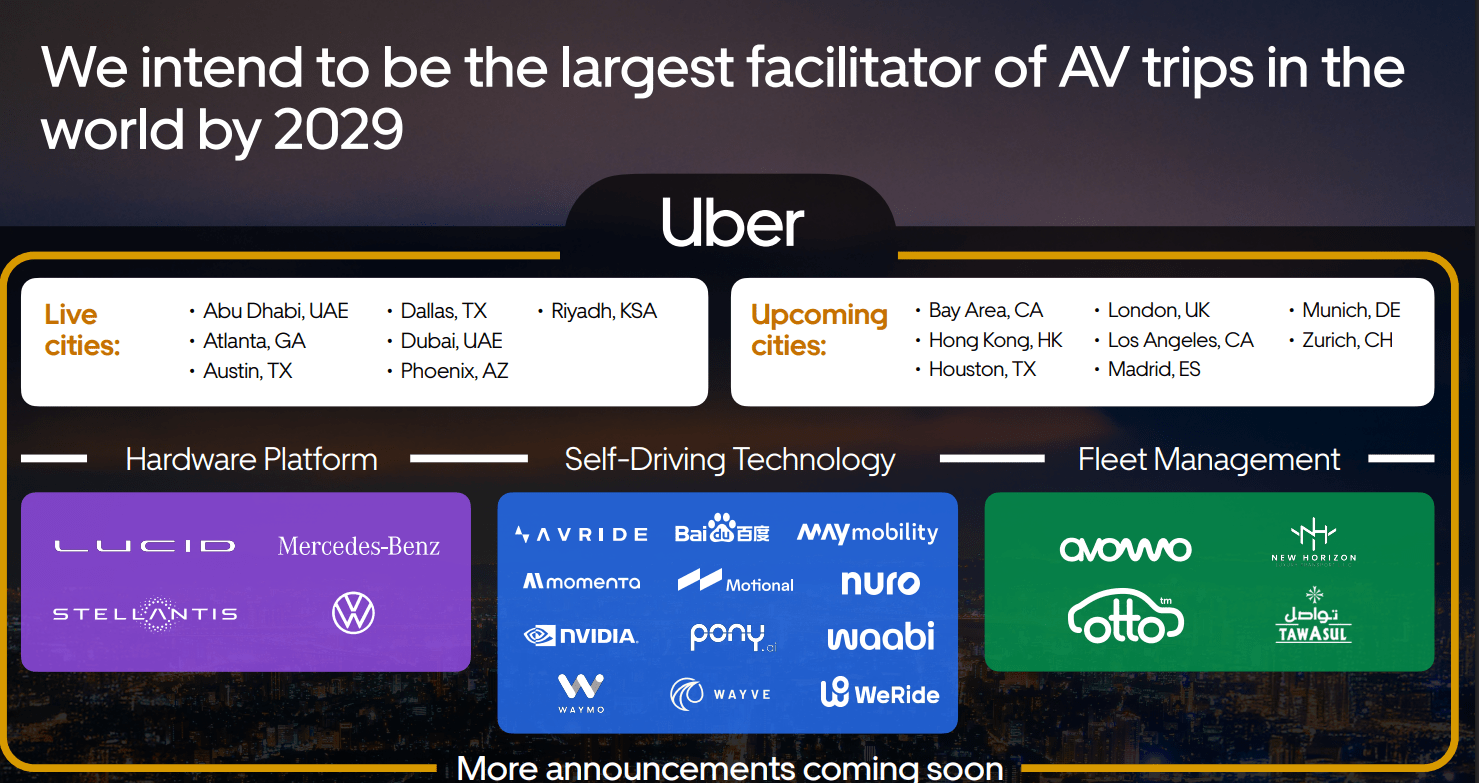
Source: Uber Q4 2025 Earnings, Autonomous Vehicles Spotlight
2️⃣ Delivery Expansion & Platform Growth
Uber is expanding its Delivery segment beyond food into groceries, retail, and everyday products.
This expansion is supported by a growing number of key partnerships across retail and grocery:
Kroger → nationwide grocery delivery through Uber apps
ALDI → on-demand grocery delivery across the U.S.
Sephora → on-demand beauty delivery across North America
Best Buy → delivery of electronics and tech products
Dollar Tree & Dollar General → everyday household essentials delivered nationwide
These partnerships show how Uber is moving beyond food into a broader commerce platform, increasing app usage.
3️⃣ New Monetization Layers
Uber is adding new revenue streams on top of its platform.
Uber Ads has grown into a $2B+ business, where merchants pay for sponsored listings and visibility in the app, with growth of over 50% last year.
Uber One is a subscription that increases customer retention and encourages people to use multiple services. It now has 30M+ subscribers.
These layers increase revenue per user and improve margins.
4️⃣ Expansion & Acquisitions
Uber continues to expand its ecosystem through acquisitions and new services.
The acquisition of SpotHero adds parking to the Uber app, while Getir / Trendyol Go strengthens its position in grocery and delivery in Turkey.
The company is also exploring new formats such as Uber Air, in partnership with Joby Aviation.
5️⃣ Profitability & Scale
Uber has reached a turning point in its financial profile. The company is now consistently profitable and generating strong cash flow.
In Q4 2025, adjusted EBITDA was $2.5 billion (+35%), and free cash flow was $2.8 billion. For the full year, Uber generated $10 billion in free cash flow, showing the strength of its platform at scale.
🔥 Upgrade Now and Save 30%!
Get instant access to this Uber Deep Dive, all other Deep Dives, our Portfolios & Transactions, our monthly Best Buys, 95+ Stock Battles — plus 375+ premium articles!
✅ Already trusted by 4,500+ investors.
Fundamental Analysis
Now it’s time for the fundamental analysis of Uber.
In this section, we evaluate three key areas: management, market, and financials & growth estimates. Each area contains multiple elements and each element is scored individually, leading to a final score between 0 and 100.
Final Scoring
This score reflects how fundamentally attractive we believe Uber is as an investment, ranging from:
🔴 Below 50 → Uninvestable
🟠 50 - 59 → Questionable
🟡 60 - 69 → Reasonable
🟢 70 - 79 → Quality
🔵 80 - 89 → High-Quality
🟣 90 or above → Exceptional
Unlock our scoring framework and full fundamental analysis below, and see how we score Uber on a scale from 0 to 100 — exclusively available to our paid members! ✨