


Welcome to the 12th edition of Unpacked, our monthly series where we take a deep dive into a company. This time, we’re taking a closer look at Palo Alto Networks — a global leader in cybersecurity, protecting thousands of organizations worldwide with its advanced network, cloud, and AI-driven security platforms.
We break down its story, business model, and highlight the latest developments.
Additionally, we do a detailed fundamental analysis, diving into the company’s management, market, financials, and growth estimates. We score each area separately, leading to a final score between 0 and 100. This score reflects how fundamentally attractive we believe the company is as an investment, ranging from:
🔴 Below 50 → Uninvestable
🟠 50 - 59 → Questionable
🟡 60 - 69 → Reasonable
🟢 70 - 79 → Quality
🔵 80 - 89 → High-Quality
🟣 90 or above → Exceptional
The goal? To give you a full deep dive into this company, as a complement to your own research, so you can decide if it’s the right investment for you.
In case you missed it, here you can read the previous editions of Unpacked:
Now let’s unpack the fundamentals of Palo Alto Networks and see how we score it!
History and Business Model
In 2005, Nir Zuk founded Palo Alto Networks after seeing that companies had limited insight into what was happening on their networks. Firewalls could block traffic, but didn’t show which apps were being used or who was behind it.
Zuk believed security needed to go further, not just block, but also understand what’s happening inside the network.
In 2007, Palo Alto Networks launched its first product: the Next-Generation Firewall (NGFW), introducing:
App-ID (which applications are running)
User-ID (who is behind the activity)
Content-ID (what data and threats are inside)
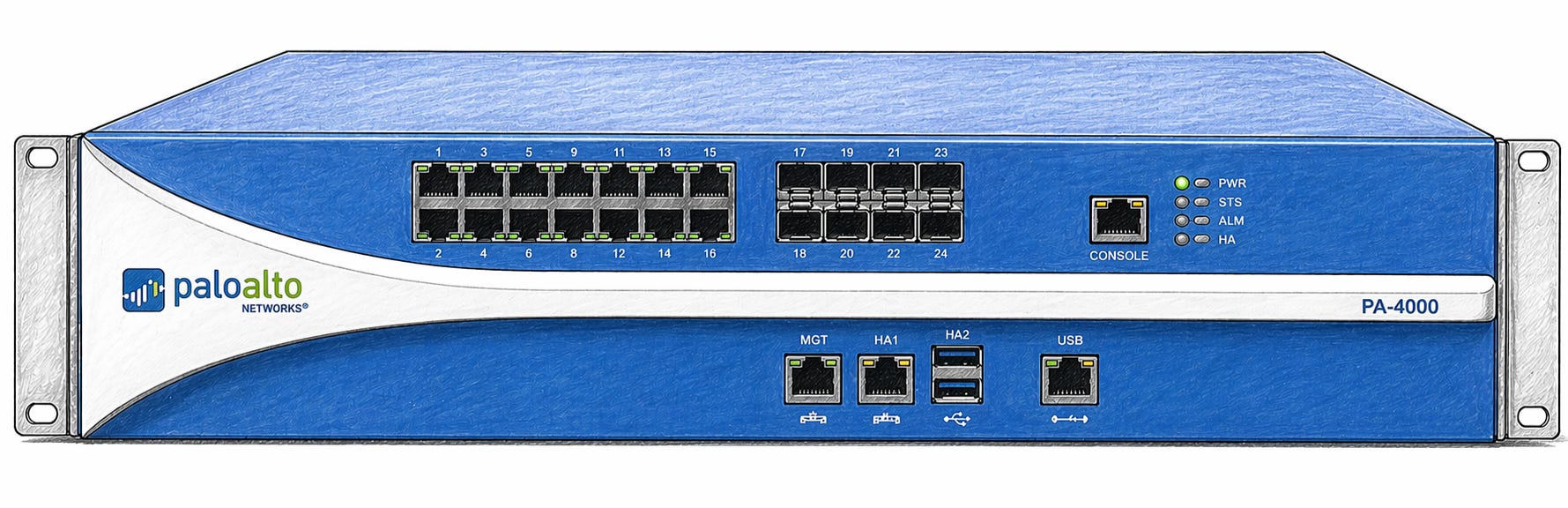
Source: Palo Alto Networks’ first next-generation firewall (PA-4000 series)
As cloud, mobile, and remote work increased, Palo Alto Networks moved beyond hardware and built a broader platform across networks, cloud, and endpoints.
In the summer of 2012, the company went public, helping expand globally.
From 2018, Palo Alto Networks moved from separate products to one integrated platform across network security, cloud security, and security operations, accelerated by acquisitions such as Evident.io (2018), RedLock (2018), and Demisto (2019).
Today, its platform is built around three core areas:
🔐 1. Network Security
☁️ 2. Prisma Cloud
🤖 3. Cortex
Over the past few years, Palo Alto Networks has been adding AI to detect and respond to threats faster, and now serves tens of thousands of organizations worldwide.
Its mission says it all:
“To be the cybersecurity partner of choice, protecting our digital way of life.”
Want to go deeper? A recent podcast with Nir Zuk and CEO Nikesh Arora shares the full Palo Alto Networks story 🎧👇
Source: Sequoia Capital, Crucible Moments Podcast
Business Model Explained
Palo Alto Networks helps companies stay secure in a world where everything is connected, from office networks to cloud systems and employee devices.
Instead of using many separate security tools, customers can use one platform that covers multiple areas of cybersecurity.
Its business is built around three core areas:
🔐 1. Network Security
Protects company networks with firewalls and software that monitor and control traffic. This is where the company started.
☁️ 2. Prisma Cloud
Secures cloud environments like AWS, Azure, and Google Cloud. As more companies move to the cloud, this has become a key growth area.
🤖 3. Cortex
Helps security teams detect and respond to threats using automation and AI, reducing manual work and improving response times.
How Palo Alto Networks makes money 💰
The model combines products with recurring subscriptions. Companies often start with a firewall or a specific product, but most revenue comes from ongoing subscriptions for threat detection, cloud security, monitoring, and continuous updates.
As customers add more products over time, revenue becomes more predictable and grows. Once a company uses one part of the platform, it becomes easier to expand into others, leading to more products per customer, higher switching costs, and deeper integration in daily operations.
Revenue Breakdown
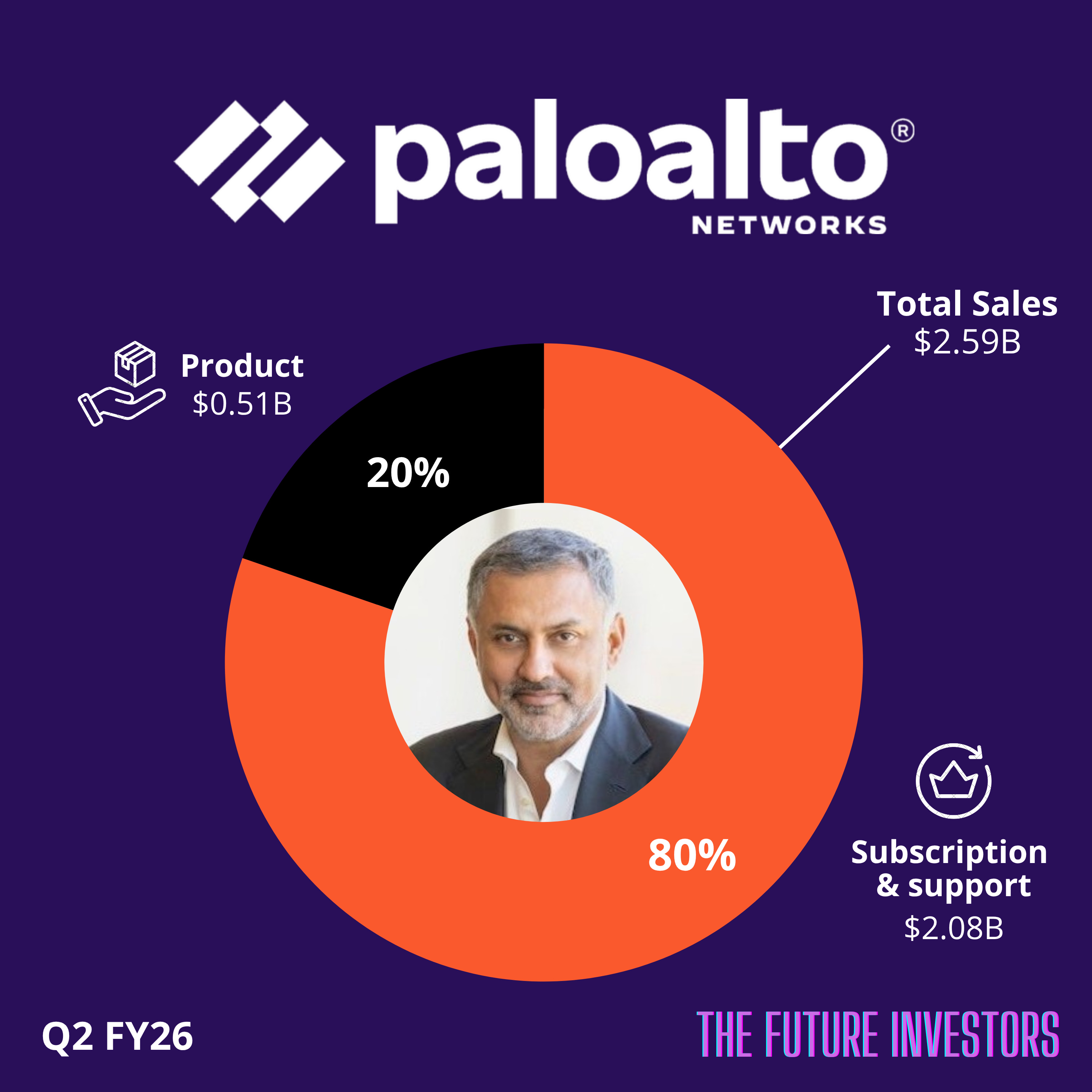
On February 17, 2026, Palo Alto Networks reported its fiscal Q2 2026 results (quarter ended January 31, 2026). Total revenue came in at $2.59B (+15% YoY).
🔄 Subscription & Support – $2.08B (80%)
Recurring revenue from cloud security, threat detection, and ongoing services. This is where most of the growth comes from, as customers use more parts of the platform.
🔐 Product – $0.51B (20%)
Includes hardware like firewalls, plus the basic software that runs on them. This is a smaller part of the business, but still growing and important for bringing in new customers.
Recent Developments
Palo Alto Networks is moving beyond firewalls into a broader platform across cloud, AI, identity, and security operations. Here are the key developments:
1️⃣ Strategic Acquisitions
In 2025 and 2026, Palo Alto Networks made several acquisitions to expand into new areas of cybersecurity:
Protect AI ($650M+): early move into securing AI models and applications
Chronosphere ($3.3B): helps monitor and secure large amounts of data
CyberArk ($25B): adds identity security for users, machines, and AI agents
Koi ($400M): focused on securing AI agents and endpoints
These deals show a clear direction: the company is building out its platform across AI, data, and identity.
2️⃣ AI & New Product Launches
Palo Alto Networks launched new products focused on AI security:
Prisma AIRS 3.0: helps companies discover, monitor, and protect AI systems from development to real-world use
Prisma Browser for Business: secures work done in the browser, where employees increasingly use SaaS tools and AI applications
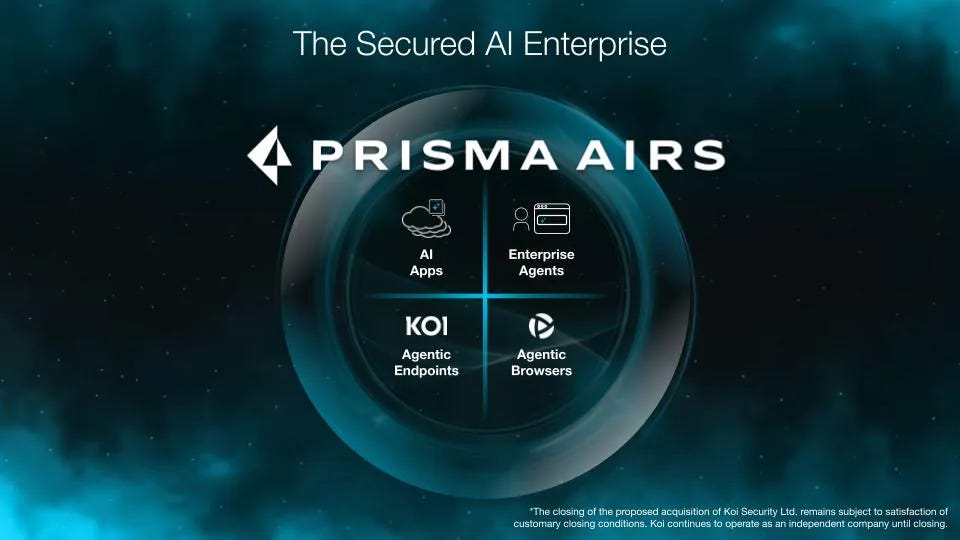
Source: Palo Alto Networks Blog - Securing the AI Enterprise
These launches show how cybersecurity is shifting. More work is happening in the cloud and the browser, and more processes are supported by AI, creating new risks that need to be secured.
3️⃣ Google Cloud Partnership & Migration
Palo Alto Networks expanded its partnership with Google Cloud through a multi-billion dollar deal.
The company is moving part of its own systems to Google Cloud, while also integrating its security tools more deeply into Google’s platform. This includes protecting AI workloads and data using solutions like Prisma AIRS.
Palo Alto Networks is also using Google’s AI models within its own platform, showing a deeper level of integration beyond a typical partnership.
This also supports products like Prisma SASE, as companies move more of their networks and applications to the cloud and look to use fewer vendors.
4️⃣ Founder Nir Zuk Steps Down
In 2025, founder and CTO Nir Zuk stepped down after leading the company’s technology strategy for nearly two decades.
Lee Klarich, a long-time product leader at the company, took over as CTO. He has been closely involved in building many of the company’s key products.
5️⃣ Project Glasswing: Collaboration with Anthropic
Palo Alto Networks is a launch partner in Project Glasswing, an initiative led by Anthropic. The project uses advanced AI models to automatically find and fix software vulnerabilities. This is important because AI is not only used by companies, but also by attackers.

Source: Anthropic website
Together, these developments show how Palo Alto Networks is building a broader cybersecurity platform, with AI at the center.
🔥 Upgrade Now and Save 30%!
Get instant access to this Palo Alto Networks Full Deep Dive, all other Deep Dives, our Portfolios & Transactions, our monthly Best Buys, 95+ Stock Battles — plus 375+ premium articles!
✅ Already trusted by 4,600+ investors.
Fundamental Analysis
Now it’s time for the fundamental analysis of Palo Alto Networks.
In this section, we evaluate three key areas: management, market, and financials & growth estimates. Each area contains multiple elements and each element is scored individually, leading to a final score between 0 and 100.
Final Scoring
This score reflects how fundamentally attractive we believe Palo Alto Networks is as an investment, ranging from:
🔴 Below 50 → Uninvestable
🟠 50 - 59 → Questionable
🟡 60 - 69 → Reasonable
🟢 70 - 79 → Quality
🔵 80 - 89 → High-Quality
🟣 90 or above → Exceptional
Unlock our scoring framework and full fundamental analysis below, and see how we score Palo Alto Networks on a scale from 0 to 100 — exclusively available to our paid members! ✨
First, let’s walk through our scoring framework 📊👇