


Welcome to the 14th edition of Unpacked, our monthly series where we take a deep dive into a company. This time, we’re taking a closer look at IonQ — a pure-play quantum computing company focused on solving problems that are far too complex for today’s most powerful computers.
We break down its story, business model, and highlight the latest developments.
Additionally, we do a detailed fundamental analysis, diving into the company’s management, market, financials, and growth estimates. We score each area separately, leading to a final score between 0 and 100. This score reflects how fundamentally attractive we believe the company is as an investment, ranging from:
🔴 Below 50 → Uninvestable
🟠 50 - 59 → Questionable
🟡 60 - 69 → Reasonable
🟢 70 - 79 → Quality
🔵 80 - 89 → High-Quality
🟣 90 or above → Exceptional
The goal? To give you a full deep dive into this company, as a complement to your own research, so you can decide if it’s the right investment for you.
In case you missed it, here you can read the previous editions of Unpacked:
Now let’s unpack the fundamentals of IonQ and see how we score it!
History and Business Model
The story of IonQ began in 2015, when scientists Christopher Monroe and Jungsang Kim founded the company after years of quantum computing research at the University of Maryland and Duke University.
They believed quantum computers could one day solve some problems much faster than even the world's most powerful computers. With that vision in mind, they founded IonQ to make quantum computing useful for the real world.
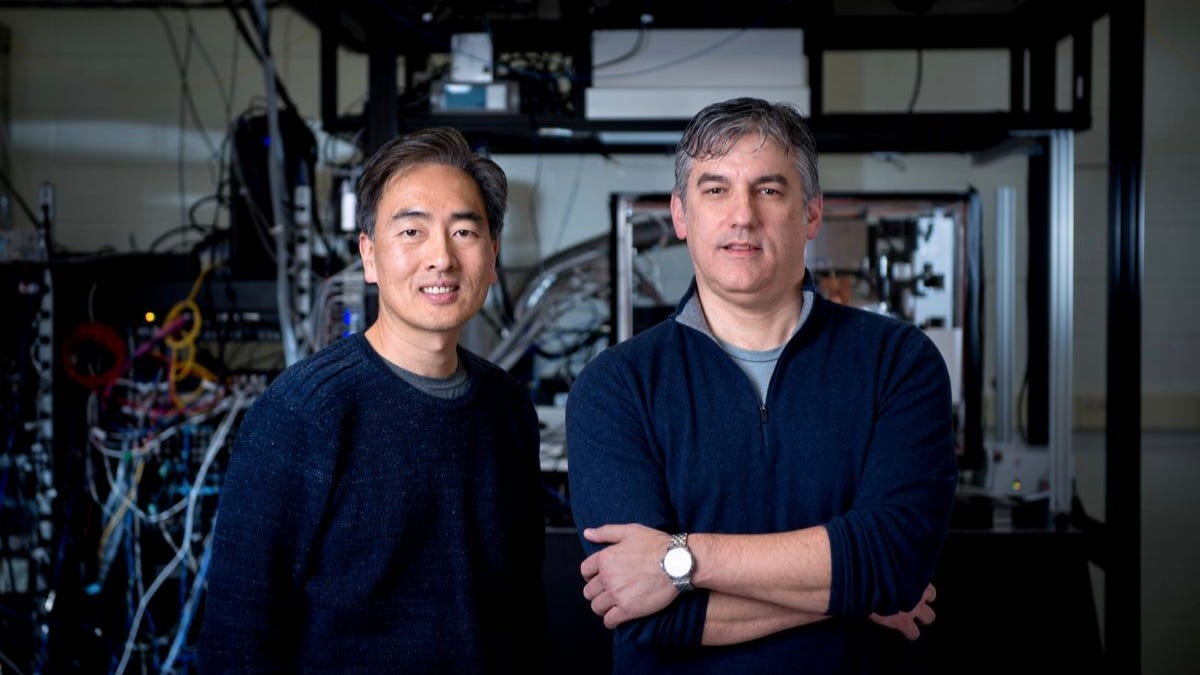
Source: The Science Monitor - Founders Jungsang Kim and Christopher Monroe
During its first years, IonQ focused on improving its technology and building more powerful quantum computers. Since day one, the company has focused on trapped-ion technology, which is still the foundation of its quantum computers today.
An important step came in 2019, when IonQ made its quantum computers available through the cloud. Instead of needing access to expensive equipment, researchers, developers, and businesses could use IonQ’s systems through platforms such as Amazon Web Services. This helped bring quantum computing to a much larger audience and was one of the company's first steps toward commercialization.
In 2021, IonQ became the first pure-play quantum computing company to go public. The company entered the stock market through a merger with a SPAC called dMY Technology Group III. The deal valued IonQ at $2 billion and brought the company to the New York Stock Exchange under the ticker symbol IONQ.
Since then, IonQ has continued to improve its technology, expand its partnerships, and grow its customer base. The company is also the only quantum computing company available through Amazon Web Services, Microsoft Azure, and Google Cloud.
Over the years, IonQ has expanded beyond quantum computing. The company is building a full-stack quantum platform that includes quantum computing, quantum networking, quantum security, and quantum sensing technologies.
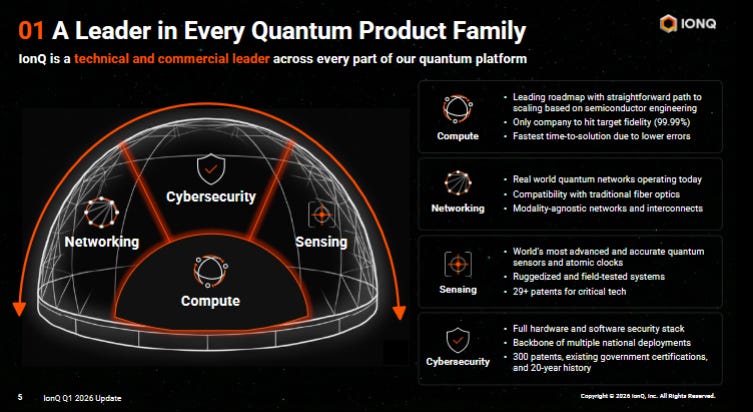
Source: IonQ First Quarter 2026 Earnings Presentation
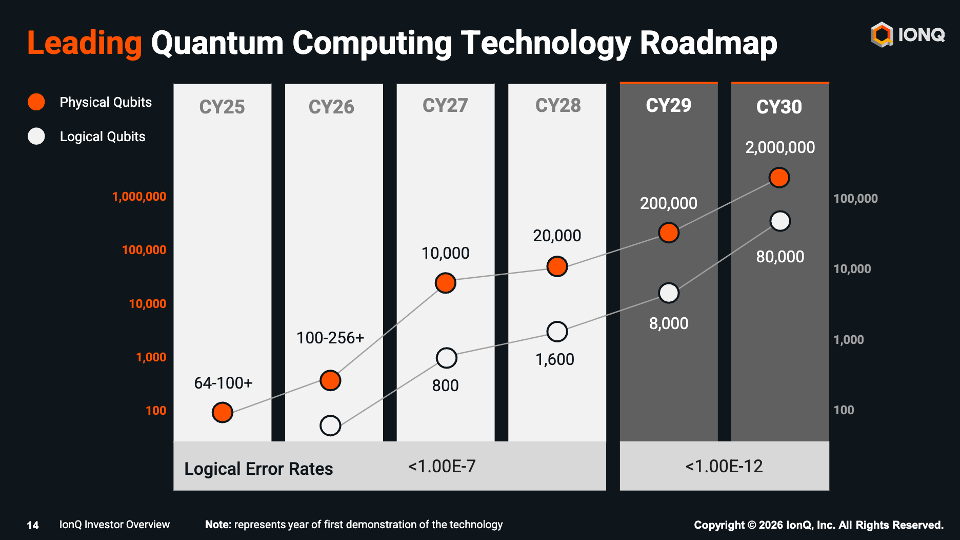
IonQ's goal is to build quantum computers with up to 2 million qubits by 2030. The company believes these systems could help solve complex problems in areas such as drug discovery, artificial intelligence, cybersecurity, logistics, and defense.
Today, IonQ is focused on making quantum computing more powerful, accessible, and practical for real-world applications.
Its mission is:
“To develop the world’s best quantum technology to solve the world’s most complex problems.”
Business Model Explained
IonQ is building a new type of computing platform based on quantum technology. Instead of selling quantum computers directly, the company gives customers access to its systems through the cloud. This means researchers, businesses, and governments can use quantum computing without owning the hardware themselves.
While most of IonQ’s revenue still comes from quantum computing, the company is building a broader quantum platform with four main focus areas:
💻 1. Quantum Computing
This is IonQ’s core business today and its main source of revenue. Customers can use IonQ’s quantum computers through platforms such as Amazon Web Services, Microsoft Azure, and Google Cloud.
🌐 2. Quantum Networking
IonQ is developing technology that could connect quantum computers together, similar to how the internet connects traditional computers today.
🔒 3. Quantum Security
Through acquisitions such as ID Quantique, IonQ is building technologies that help protect data and communications from future cyber threats.
📡 4. Quantum Sensing
IonQ is also developing sensors that can make highly accurate measurements for applications such as defense, navigation, and scientific research.
This strategy is already starting to pay off. Today, more than one-third of IonQ’s revenue comes from customers using multiple IonQ products.
How IonQ Makes Money 💰
IonQ currently earns most of its revenue from:
☁️ Access to quantum computers through cloud platforms
🏛️ Government and research contracts
🤝 Commercial partnerships and development projects
It is important to remember that quantum computing is still in its early stages. Most customers are currently testing and exploring the technology rather than using it in everyday operations.
IonQ is investing heavily today because management believes quantum computing could become much more widely used in the future. If that happens, the company could benefit from one of the largest emerging opportunities in the technology industry.
Revenue Breakdown
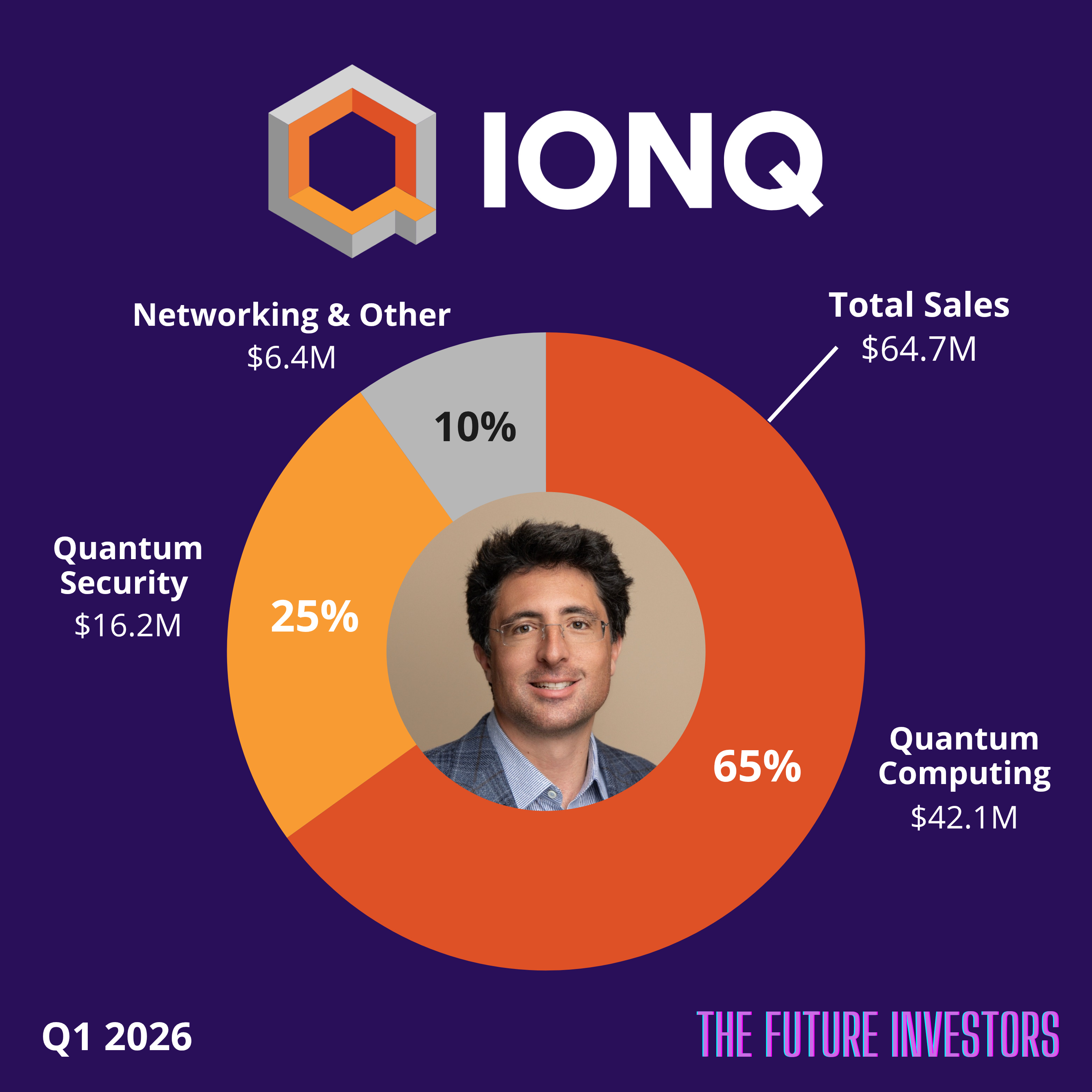
On May 6, 2026, IonQ reported its first quarter 2026 results. Total revenue came in at $64.7 million (+755% YoY).
The revenue breakdown is estimated based on company disclosures, acquisitions, and management commentary. IonQ does not report revenue by segment.
💻 Quantum Computing – $42.1 million (65%)
IonQ's core business and main source of revenue. This includes access to quantum computers through cloud platforms, commercial contracts, and government contracts and projects.
🔒 Quantum Security – $16.2 million (25%)
Primarily driven by ID Quantique, which develops technologies that help protect data and communications from future cyber threats.
🌐 Networking & Other – $6.4 million (10%)
Includes newer activities such as quantum networking, sensing, and other technologies that could become important growth drivers in the future.
Recent Developments
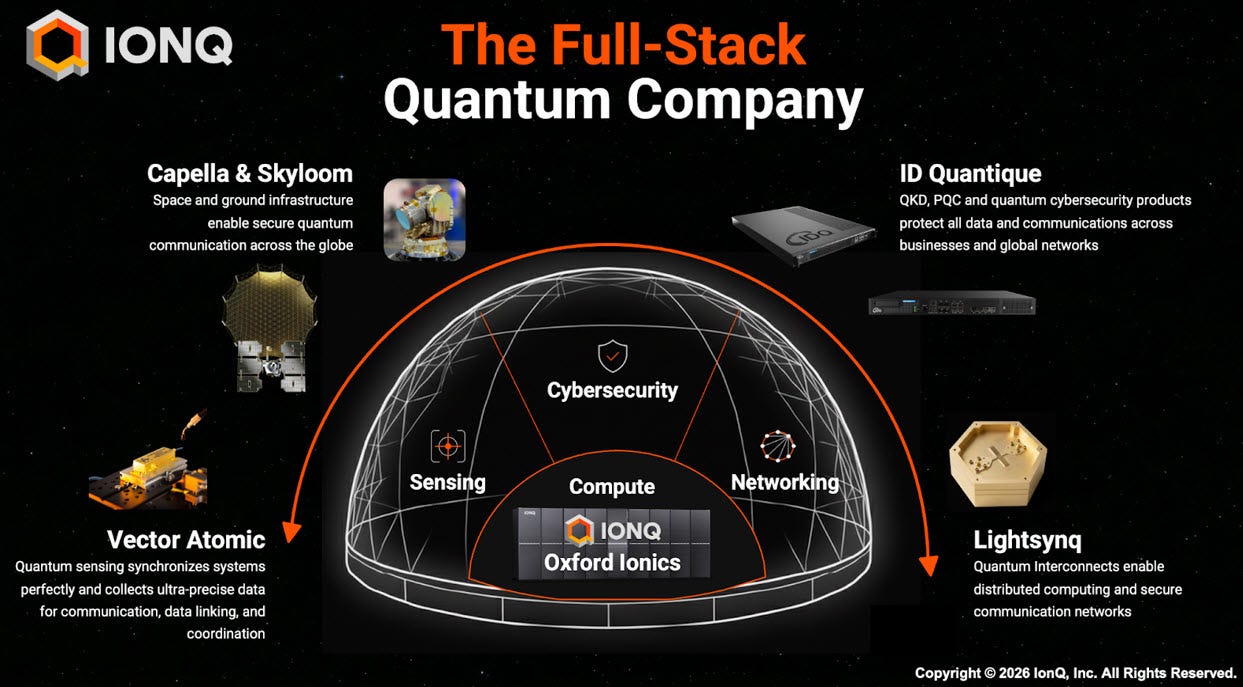
The past 18 months have been very important for IonQ. Through acquisitions, partnerships, and new initiatives, the company has expanded beyond quantum computing into areas such as networking, security, sensing, and space infrastructure.
Source: IonQ - Moor Insights & Strategy
Here are the key developments:
1️⃣ Niccolo de Masi Becomes CEO
In February 2025, Niccolo de Masi became President and CEO of IonQ, replacing Peter Chapman. De Masi had served on IonQ's board since 2021 and was already familiar with the company. Since becoming CEO, he has accelerated IonQ's acquisition strategy and expanded the company's strategy beyond quantum computing.
2️⃣ Oxford Ionics Acquisition Accelerates the Roadmap
In June 2025, IonQ announced the acquisition of Oxford Ionics in a deal valued at $1.08 billion.
Oxford Ionics develops advanced trapped-ion quantum computing technology. The acquisition strengthens IonQ's technology roadmap and could help the company achieve its goal of building quantum computers with up to 2 million qubits by 2030.
3️⃣ Building a Quantum Networking Leader
IonQ has made quantum networking a major focus area. Through acquisitions including Lightsynq, Qubitekk, and Skyloom, the company has expanded its capabilities in quantum networking, optical communications, and networking infrastructure.
The long-term goal is to help build the infrastructure needed for a future quantum internet, where quantum computers can communicate with each other through highly secure networks.
4️⃣ Expansion into Quantum Security
In May 2025, IonQ completed the acquisition of ID Quantique, a Swiss company specializing in quantum security and quantum networking.
The deal added products for secure communications, encryption, and quantum-safe cybersecurity. It also brought an established business with existing customers, revenue, and more than 300 patents to IonQ.
5️⃣ Expansion into Space & Quantum Sensing
IonQ also expanded into new markets through the acquisitions of Capella Space and Vector Atomic.
Capella Space added satellite and space infrastructure capabilities, while Vector Atomic brought quantum sensing and precision timing technologies. Together, these acquisitions broadened IonQ’s exposure to defense, navigation, and space-related applications.
6️⃣ Roadmap to 2 Million Qubits by 2030
At its 2025 Analyst Day, IonQ announced plans to build quantum computers with up to 2 million qubits by 2030. Management believes these systems could unlock new applications in areas such as artificial intelligence, drug discovery, cybersecurity, logistics, and defense.
Source: IonQ May 2025 Investor Presentation
🔥 Upgrade Now and Save 30%!
Get instant access to this IonQ Full Deep Dive, all other Deep Dives, our Portfolios & Transactions, our monthly Best Buys, 95+ Stock Battles — plus 400+ premium articles!
✅ Already trusted by 4,800+ investors.
Fundamental Analysis
Now it’s time for the fundamental analysis of IonQ.
In this section, we evaluate three key areas: management, market, and financials & growth estimates. Each area contains multiple elements and each element is scored individually, leading to a final score between 0 and 100.
Final Scoring
This score reflects how fundamentally attractive we believe IonQ is as an investment, ranging from:
🔴 Below 50 → Uninvestable
🟠 50 - 59 → Questionable
🟡 60 - 69 → Reasonable
🟢 70 - 79 → Quality
🔵 80 - 89 → High-Quality
🟣 90 or above → Exceptional
Unlock our scoring framework and full fundamental analysis below, and see how we score IonQ on a scale from 0 to 100 — exclusively available to our paid members! ✨
First, let’s walk through our scoring framework 📊👇